Research news
Researchers in Japan have developed a lipocalin-based drug delivery system that dramatically increases the solubility of the anticancer drug paclitaxel and enhances tumour suppression in a breast cancer mouse model, offering a promising strategy to deliver poorly soluble chemotherapeutic agents more selectively to cancer tissue
Recent progress in pharmaceutical discovery has produced a wide range of candidate therapeutics with strong biological activity. Yet many of these compounds present substantial practical challenges during development and clinical use. A significant proportion of modern small molecule and macromolecular drug candidates exhibit low aqueous solubility or large molecular size, properties that complicate formulation and hinder efficient absorption within the body, frequently limiting reduce bioavailability.
However, a research team led by Professor Takashi Inui at Osaka Metropolitan University, Japan, has reported progress toward such a strategy through the design of a targeted delivery platform for paclitaxel – a widely used anticancer drug – that remains difficult to formulate because of its extremely poor water solubility. Paclitaxel has a molecular weight of around 854 Daltons and tends to aggregate in aqueous solutions complicating both administration and therapeutic delivery.
In addition, conventional administration often causes drugs to distribute throughout healthy tissues rather than concentrate within tumours. Such non-specific distribution leads to systemic toxicity and severe side effects. As a result, intense international research efforts have focused on the development of drug delivery systems that can improve solubility, stabilise compounds in circulation and direct them to diseased tissue.
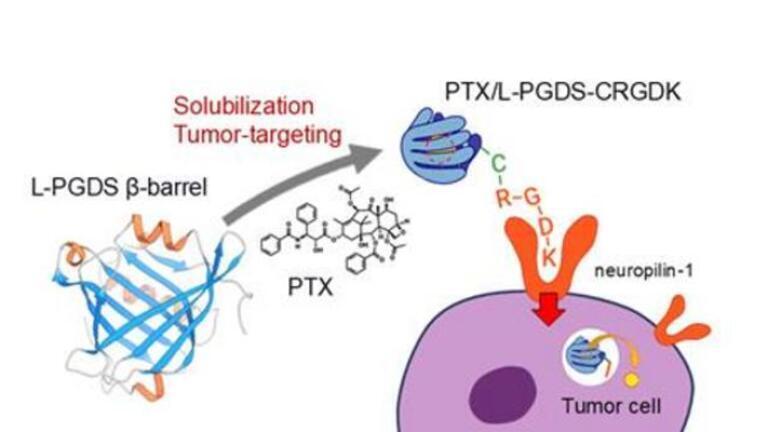
To address this limitation, the researchers investigated the potential of lipocalin-type prostaglandin D synthase as a carrier molecule. Lipocalin-type prostaglandin D synthase is a naturally occurring protein with a characteristic β-barrel structure that forms a hydrophobic cavity capable of binding small molecules. The team proposed that this structural feature might allow the protein to encapsulate hydrophobic anticancer drugs and transport them within biological fluids.
Through a combination of molecular docking simulations and experimental solubility testing, the investigators examined how paclitaxel interacts with the carrier protein. Their analysis revealed that the drug bound primarily through hydrophobic interactions to the upper region of the β-barrel cavity within lipocalin-type prostaglandin D synthase. This binding configuration stabilised the drug within the protein pocket and prevented aggregation in aqueous environments.
When the drug was suspended in phosphate-buffered saline alone it remained largely insoluble. However, association with the lipocalin carrier dramatically increased solubility by almost 3,600-times. Such a substantial improvement suggested that the carrier could enable efficient systemic delivery of a drug that otherwise proves extremely difficult to dissolve and administer.
The researchers next sought to enhance the system further by introducing tumour targeting capability. They attached a peptide sequence known as CRGDK to the C-terminal region of the carrier protein. This peptide binds specifically to neuropilin-1 receptors which occur at elevated levels on the surface of many cancer cells. By incorporating this targeting sequence, the investigators created a modified carrier termed L-PGDS-CRGDK that could potentially preferentially direct the drug to malignancy.
To test therapeutic performance, the team used a mouse model implanted with MDA-MB-231 human breast cancer cells – a widely studied model for aggressive triple-negative breast cancer.
They compared three treatment approaches:
During the period of treatment, the standard commercial formulation demonstrated measurable antitumour activity. However, tumour suppression diminished once administration ended, a pattern consistent with the rapid clearance and non-specific distribution that often limit conventional chemotherapy.
In contrast, the experimental delivery systems produced more sustained therapeutic outcomes. Both paclitaxel bound to lipocalin-type prostaglandin D synthase and the targeted L-PGDS-CRGDK formulation maintained antitumour effects even after dosing ceased. Among the tested approaches, the targeted system produced the strongest tumour suppression, which indicated that receptor-directed delivery substantially improved therapeutic localisation and persistence.
Lipocalins represent a family of proteins known for their capacity to bind hydrophobic molecules within internal cavities. Researchers have explored their use as carriers for imaging agents, small molecules and biologically active compounds. The Osaka Metropolitan University study suggests that these proteins may also serve as versatile platforms to transport relatively large and poorly soluble anticancer drugs.
By improving solubility, stabilising drugs in circulation and directing them toward tumour cells, such systems could reduce the dose required to achieve clinical efficacy. Lower systemic exposure may in turn lessen toxic side effects, one of the most serious drawbacks of traditional chemotherapy regimens.
“L-PGDS can bind relatively large drugs with molecular weights up to approximately 850 and the results revealed that the introduction of a targeting peptide enabled selective delivery of anticancer drugs to cancer cells,” said Professor Inui.
“The drug delivery system developed in this study is anticipated to contribute significantly to future cancer treatment as a novel strategy to transport poorly soluble anticancer drugs,” he added.
The study therefore illustrates how protein-based carriers may address two persistent challenges in oncology drug development – solubility and tumour specificity. If further research confirms the approach in additional tumour models and eventually in clinical studies, lipocalin-based carriers could provide an adaptable platform to deliver a wide range of difficult-to-formulate therapeutic molecules.
For further reading please visit: 10.1021/acsomega.5c09324
ILM 51.6 Sept 2026



 Product directory




















,-photo-Karin-Allander.jpg)







.jpg)
