Research news
Engineered HLA-independent T cell receptors have eliminated kidney, ovarian and pancreatic tumours in laboratory studies by detecting minute levels of CD70 which may open a route to broader solid tumour immunotherapy
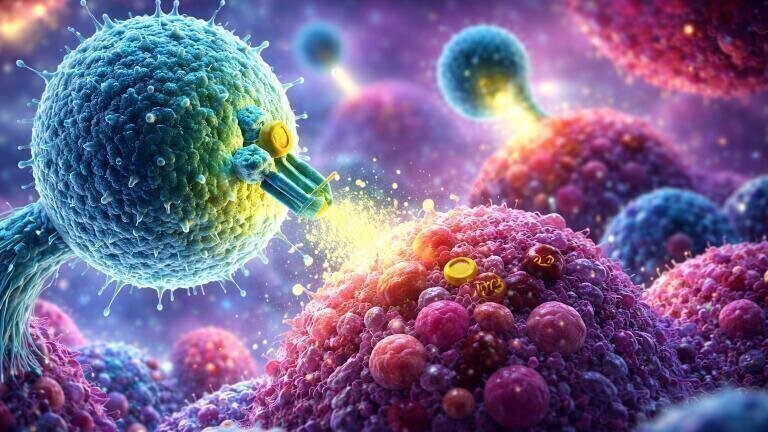
Though chimeric antigen receptor T cells (CAR T) have transformed the treatment of certain blood cancers, their impact on solid tumours has remained limited. Researchers have now developed a highly sensitive form of CAR T cell therapy that appears to overcome one of the most persistent obstacles in solid tumour immunotherapy – the absence of a single, widely shared surface antigen that marks malignant cells while sparing healthy tissue.
Chimeric antigen receptors function as engineered molecular homing devices. They equip immune cells – usually T lymphocytes – with synthetic receptors that enable them to recognise and attack cells that express a chosen target protein. Therapies that target CD19 have reshaped care for several haematological malignancies and have produced durable remissions in patients who had shown resistance to conventional treatment. Solid tumours, however, rarely present such a uniform and exclusive molecular flag.
One candidate target has been CD70, a protein that several solid tumours produce at abnormally high levels. Investigators have identified CD70 expression in a range of malignancies, yet its distribution within tumours is heterogeneous. Some cancer cells display abundant CD70, whereas neighbouring cells express little or none. This patchwork pattern has constrained the effectiveness of conventional CAR T cells, which require a threshold level of antigen expression in order to activate and destroy a target cell.
To address this limitation, Dr. Sophie Hanina and colleagues from Columbia University Irving Medical Center, New York, USA, have developed patient-derived xenograft models that reproduce the mosaic expression of CD70 which is observed in kidney cancer. These laboratory models allowed the team to interrogate tumour cell populations with high fidelity to clinical samples. The researchers found that CD70 expression lay on a continuum across all tumour cells. Even cells classified as CD70-negative expressed minute quantities of the protein, albeit at levels too low to trigger conventional CAR T cell responses.
On the basis of this insight, the team engineered an ultra-sensitive and highly selective receptor known as an HLA-independent T cell receptor. HLA refers to human leukocyte antigen, the molecular system that presents peptide fragments to T cells. By design, this novel construct operates independently of that pathway. The resulting CD70-targeted HLA-independent T cells demonstrated the capacity to detect and eliminate tumour cells that expressed extremely low levels of CD70 in both cell culture and mouse models.
In preclinical models of renal, ovarian and pancreatic cancers, the engineered cells achieved complete and durable tumour eradication, even when tumours exhibited mixed levels of CD70 expression. These findings suggest that increased receptor sensitivity may allow immunotherapy to overcome apparent antigen heterogeneity, a long-standing barrier in solid tumour treatment.
“Twenty or more solid tumour types express CD70 heterogeneously,” the authors wrote.
“Our findings position CD70 as a pan-cancer target and provide a model to uncover additional stealth targets amenable to sensitive immunotherapeutic approaches in the face of apparent tumour antigen heterogeneity.”
The study has provided a conceptual framework rather than clinical proof. Nevertheless, it has demonstrated that what appears to be antigen absence may, in fact, represent antigen scarcity.
By recalibrating immune sensitivity, researchers may extend the reach of cell-based immunotherapies beyond blood cancers to a broader spectrum of solid malignancies. If subsequent clinical studies confirm these results, the work could mark a decisive step towards more versatile and precise cancer immunotherapy.
For further reading please visit: 10.1126/science.adv7378
ILM 51.6 Sept 2026




 Product directory


















,-photo-Karin-Allander.jpg)