Research news
Scientists have discovered that Yersinia enterocolitica can regulate its type III secretion system in response to cell density, allowing the pathogen to alternate between virulent and reproductive phases. The mechanism – controlled by the protein VirF – enables the bacteria to survive immune attack before resuming growth and spread
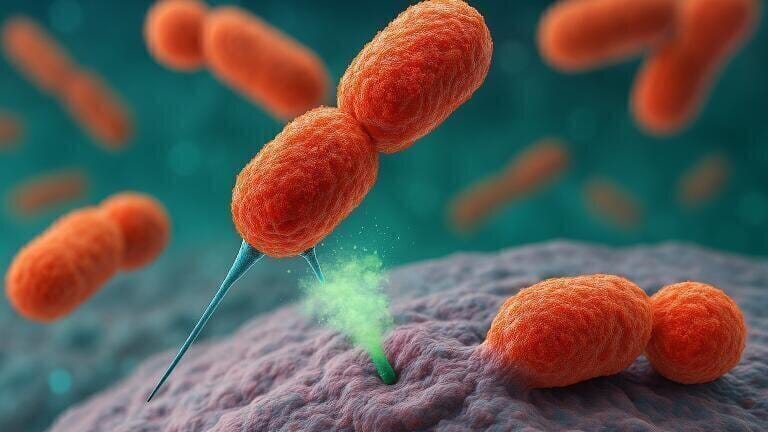
Bacterial pathogens such as Salmonella, Shigella or Yersinia deploy the type III secretion system (T3SS) – a syringe-like protein structure – to inject virulence factors directly into human cells. This injection mechanism is critical to the ability of Yersinia to suppress immune defences. Yet activation comes at a cost whereby once the system is activated, the bacteria’s ability to grow stops and lose its ability to reproduce and spread.
“Until now, it was unclear how Yersinia enterocolitica resolved this conflict between virulence and reproduction,” said Dr Andreas Diepold of the Karlsruhe Institute of Technology’s Institute for Applied Biosciences, Karlsruhe, Germany.
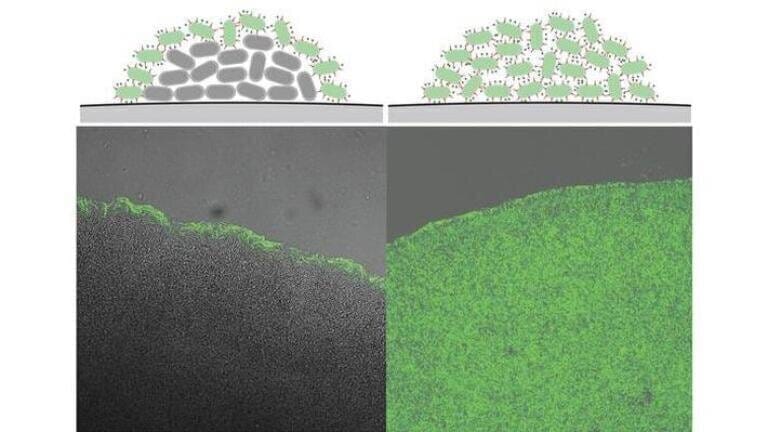
A team led by Diepold has now shown that Y. enterocolitica possesses a density sensor that regulates T3SS activity. When many bacteria accumulate in one place, a molecular mechanism switches the secretion system off, keeping it active only in the cells at the outer edge of a colony.
“That enables the bacteria that aren’t exposed to the immune system to continue reproducing.
“This is a highly specific and reversible mechanism. As soon as the bacteria spread again, the system can be reactivated,” said Diepold.
Central to this regulatory switch is the protein VirF, which drives the assembly of the secretion system. At high bacterial density, increased levels of small RNA molecules downregulate the protein complex, markedly reducing T3SS activity.
The researchers also found that the adhesion protein YadA is deactivated in unison, making the bacteria less detectable to immune cells and more mobile within the host. This change of state may help the pathogen to reach fresh tissues or form new colonies.
“Our results show that Yersinia doesn’t just passively react to environmental conditions. Instead it actively switches between a virulent and a reproductive phase,” said Diepold.
“This enables it to withstand the immune response and then reproduce efficiently afterward,” he added.
The secretion system can be reassembled between 30 to 60 minutes. The study has provided novel insight into the dynamics of bacterial infections.
“Many therapeutic approaches focus on how infections start, but we also need to know how germs behave in the body later on,” said Diepold, who emphasised that T3SS deactivation at high cell density represents an underappreciated but potentially valuable therapeutic target.
In the longer term, such findings could inform new strategies to treat bacterial infections. These might include the targeted disruption of switching mechanisms or interventions that alter how bacteria sense their density.
“The more we know about these systems, the better we can counteract them,” concluded Diepold.
For further reading please visit: 10.1371/journal.ppat.1013423
ILM 51.6 Sept 2026



 Product directory




















,-photo-Karin-Allander.jpg)







.jpg)
