Mass spectrometry & spectroscopy
Published over 14 years ago. See the latest and most current information on Mass spectrometry & spectroscopy.
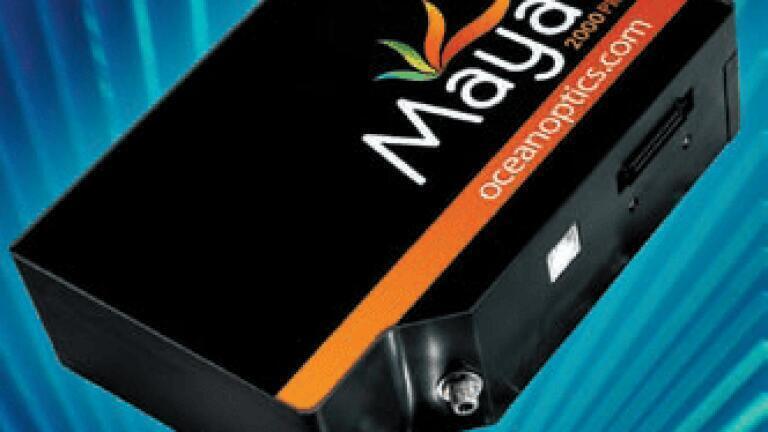
The Maya2000 Pro-VIS-NIR from Ocean Optics is a back-thinned 2D FFT-CCD spectrometer with high sensitivity, 80% peak quantum efficiency and excellent VIS-NIR response. The Maya2000 Pro-VIS-NIR is ideal for low light-level applications such as Raman, as well as for analysis of gases used in semiconductor processing and measurement of biological samples in the life sciences. The Maya2000 Pro-VIS-NIR has a low-etalon, scientific-grade detector that provides high quantum efficiency from ~400-1100nm. Other features include triggering functions for providing accurate timing and synchronisation between the spectrometer and other devices.
Three low-jitter trigger modes and normal (free-running spectral acquisition) operating modes are possible. Applications include pulsing a light source when acquiring a spectra and synchronising spectral acquisition to coordinate with samples moving through a process stream or sensors reaching a certain temperature level.
In addition, Maya2000 Pro-VIS-NIR supports RS-232 communications and has a 30-pin connector and 10 user-programmable digital I/Os. Its enhanced onboard programmable high-speed FPGA controller enables triggering and provides other performance advantages.
ILM 51.6 Sept 2026





 Product directory