Mass spectrometry & spectroscopy
Published over 10 years ago. See the latest and most current information on Mass spectrometry & spectroscopy.
FTIR spectroscopy is a non-destructive way to determine purity and characterise the contents of dairy samples. Traditional liquid cells are an effective way of detecting the lactose, protein and fat concentrations in milk, but can be time intensive.
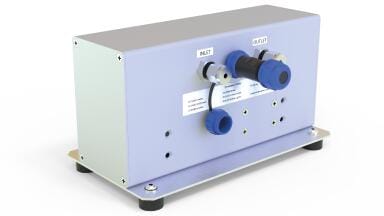
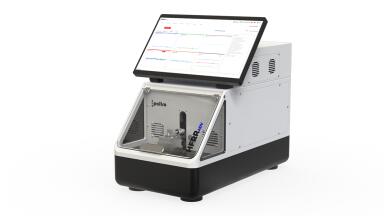
The PearlTM liquid transmission accessory can record high-quality IR spectra of milk with reproducible pathlengths as small as 25 μm. Moreover, sample loading and cleaning is easy, fast and requires little user-training, which can save a lot of time and money.
Within the PearlTM is a horizontal liquid sample cell called the Oyster Cell. Samples can be dropped onto the cell and loaded into the PearlTM for fast analysis. The lightweight, portable and robust design makes the PearlTM highly suitable for applications in the field.
Method and results
Store-bought milk samples of varying fat and lactose concentrations were tested. Each sample was dropped onto a CaF2 window and a liquid capillary film of the sample was formed by closing the upper window over the top.
The PearlTM was placed into a commercially available spectrometer to record the spectra shown.
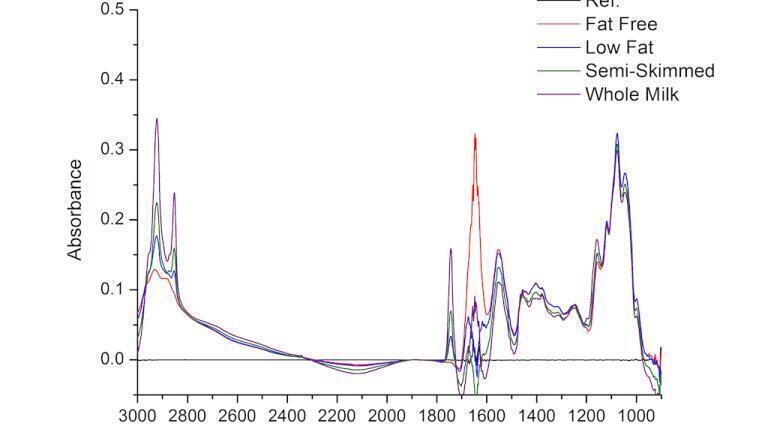
The water content of milk is >85% and significantly influences its spectrum, which is why a water background subtraction has been applied to the data.
The flavour and aroma of fats like milk lipids affect the palatability of food but the amount of fat in milk is important for suckling calves.
Figure 1 shows the spectra of fat free, low fat, semi-skimmed and whole milk, which correspond to 0, 1, 2 and 3.5 % fat, respectively. The sharp absorption bands at 2920, 2850 and 1750 cm-1 indicate dairy fats and increase in intensity with greater fat concentration.
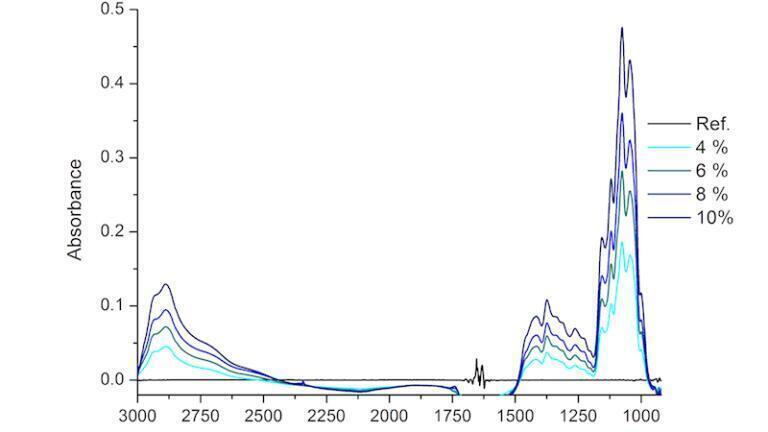
Lactose is the principal carbohydrate, accounting for roughly 5%, in milk. Therefore, quickly identifying the percentage of lactose in hundreds of milk samples can be cost-effective.
Conclusions
Spectral analysis of milk to determine fat and lactose content is simple and fast when using the PearlTM liquid transmission accessory.
Whether checking retail milk quality or ensuring the health of newborn calves, FTIR analysis is an invaluable technique for monitoring a herd’s milk production, as well as fertility and even CH4 emissions.
The ease, speed and accuracy of this technique contributes to a cost-effective dairy management system and encourages healthy cows and high quality dairy products for consumers.
For complementary IR analysis techniques on solid dairy products like cheese and yoghurt, why not look at our ATR accessory the QuestTM?
Check out product application notes, videos and other spectroscopy news on the Specac website at www.specac.com
Acknowledgement
John Coates, President of Coates Consultancy, performed independent spectroscopic analysis of the above milk samples.
References
P. Friedrichs, C. Bastin, F. Dehareng, B. Wickham, X. Massart, Biotechnol. Agron. Soc. Enviorn., 2015 19 (2), 97
F. Dehareng, C. Delfosse, E. Froidmont, H. Soyeurt, C. Martin, N. Gengler, A. Vanlierde, P. Dardenne, Animal, 2012, 6 (10), 1694
ILM 51.6 Sept 2026





 Product directory