Microscopy & microtechniques
Published over 13 years ago. See the latest and most current information on Microscopy & microtechniques.
Polypropylene (PP) is a common, commercial engineering plastic that is tough, flexible and can be manufactured via extrusion film casting (EFC). Most commercial PP is isotactic with all methyl groups orientated on the same side of the backbone of the polymer chain. This orientation of the methyl groups within the polymer relative to each other directly influences the ability of the polymer to form crystals.
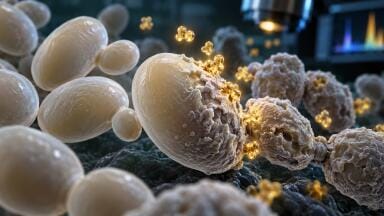
DMDBS (dimethyl dibenzylidene sorbitol) is a butterfly shaped molecule that is used as a nucleating agent in the manufacture of PP via EFC. It forms crystalline nanofibres (approx 5nm diameter) when it precipitates out of a hot melt of isotactic PP (iPP). These nanofibres form a mesh. At cooler temperatures, iPP (α-form) crystals nucleate on the surface of these fibres.
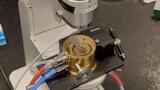
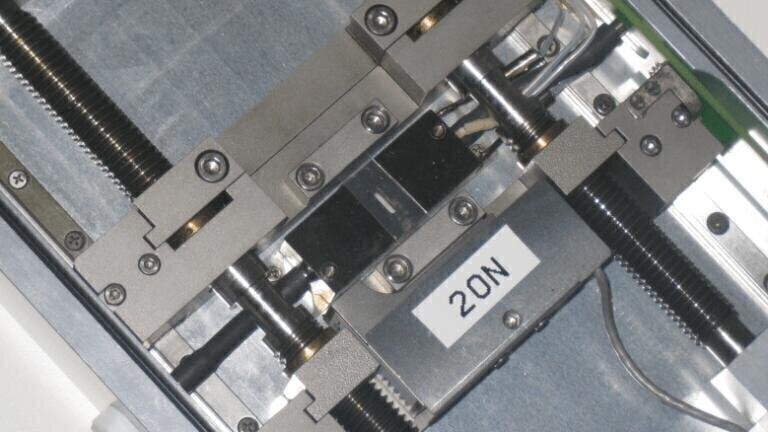
Guruswamy Kumaraswamy and a group of scientists from the National Chemical Laboratory (NCL) of India have used a Linkam TST350 tensile testing temperature stage to look at the influence of this semi-crystalline morphology on the mechanical characteristics of the film.
Homopolymer iPP pellets were coated with DMDBS using a DMDBS solution in acetone. These pellets, with 0.2%, 0.4%, or 0.8% (by weight) DMDBS were extruded through a ThermoHaake PolyLab single screw extruder. This created a film of a constant thickness of 0.45mm as the film was taken up on chill rolls (10°C). To achieve six different draw ratios, the speed of the chill rolls was varied.
These films were tested using the Linkam TST350 stage. The stage is built to maintain perfect uniform vertical and horizontal alignment during testing. Temperature control and accuracy is second to none, with a range from -196 to 350°C with 0.1°C control and up to 60°C/min heating rate.
It was observed that at TDIE=200°C voids form within the 0.8% DMDBS film during extrusion. This, the scientists hypothesised, was the reason why the 0.8% film exhibiting a decrease in yield stress and modulus values compared to neat iPP film and the 0.2% & 0.4% films. The 0.2% and 0.4% DMDBS PP films exhibit a ≈50% increase in modulus and yield strength compared to neat PP. This is observed to be higher in the transverse direction. More information can be found in the paper ‘the influence of DMDBS on the morphology and mechanical properties of polypropylene cast films’ by K. Sreenivas, Harshawardham V.Pol, and Guruswamy Kumaraswamy.
ILM 51.6 Sept 2026




 Product directory


.jpg)