News
Published over 12 years ago. See the latest and most current information on News.
Researchers from the University of Dundee have defined the structure of a recently discovered enzyme, raising the possibility of learning more about the evolution of organisms over billions of years.
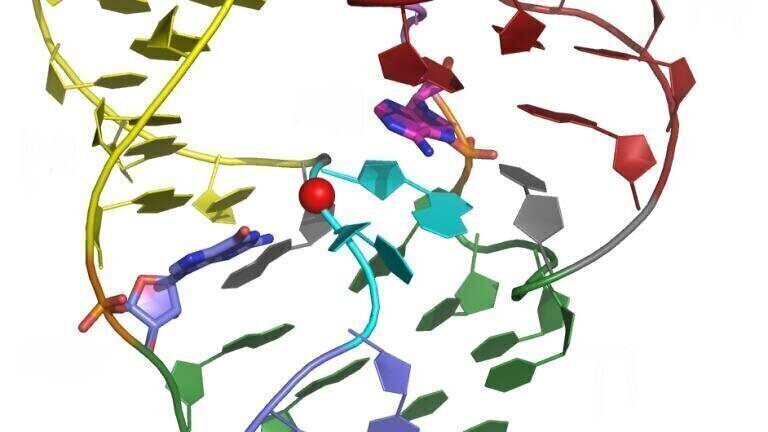
Using X-ray crystallography, Professor David Lilley and a team from the Cancer Research UK Nucleic Acid Structure Research Group at Dundee’s College of Life Sciences were able to determine the three-dimensional structure and mechanism of action of the ‘twister’ ribozyme, just five months after it was discovered by scientists at the University of Yale earlier this year.
While most enzymes are made up of protein, ribozymes are enzymes that are made of RNA. They speed up some of the most important chemical reactions in the cell, and are thought to have played a key role in the origin of life on the planet.
The Yale team named their new ribozyme twister because it resembles the Egyptian hieroglyph "twisted flax". This species accelerates the cleavage of a specific location in RNA by about a million-fold. This has been found to be very widespread, occurring in bacteria, animals and plants, although the precise role played by twister in the control of gene expression and other processes remains unclear.
“Most molecular changes are governed by proteins, but we know that two of the most important of these inside living cells are actually catalysed by ribozymes,” said Professor Lilley. “The discovery of this new RNA by the Yale team raised the obvious question – what does it do? “We can think of ribozymes as molecular fossils that give clues to the evolutionary journey of organisms and when I gaze into their structures I feel like I’m peering back over 3 billion years of evolution. Discovering the purpose of the twister ribozyme will tell us more about its current function in living cells and determining the structure takes us a big step closer to that.”
The research is published in Nature Chemical Biology
ILM 51.6 Sept 2026

 Product directory












.jpg)
,-photo-Karin-Allander.jpg)







.jpg)



.jpg)
