Temperature control and sterilising
Published over 9 years ago. See the latest and most current information on Temperature control and sterilising.
Satellites that circle the earth are an important part of today's world. Whether a research or weather satellite, the body must withstand extreme temperature differences in outer space to fulfill its tasks. A highly complex test procedure during the manufacturing process ensures product quality and the later faultless deployment of the satellites. The satellite transmitter units of Thales also undergo such a procedure. The high number of single-space tempering units located in a single room was a real challenge for the Lauda solution concept, as the heat generated by the tempering devices and the air flows associated with their operation affect the work results on the one hand, while emissions, noise and dust lead to working conditions that are anything but optimal on the other hand.
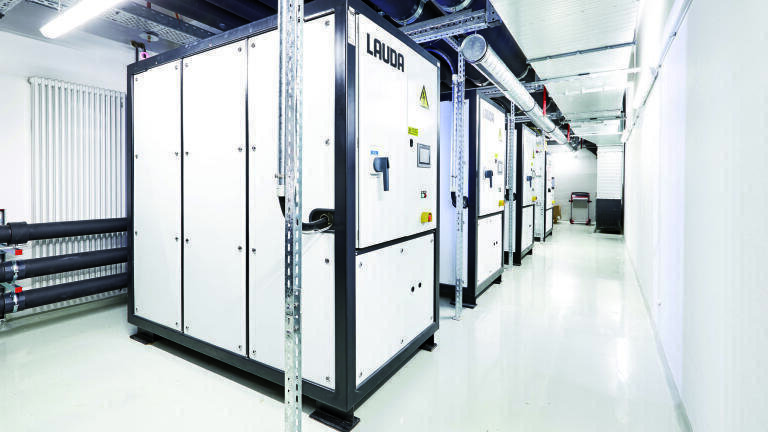
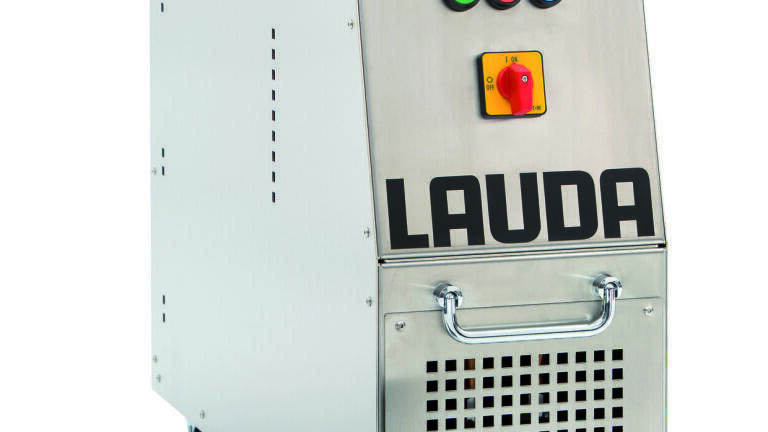
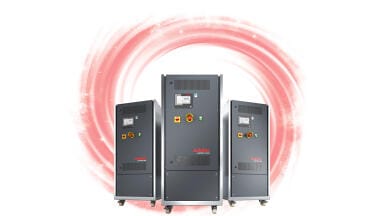
For this project, the temperature specialist Lauda supplied a complete central cold supply consisting of 3 DV cooling modules with a total cooling output of 75 kilowatt at -50°C, including a separate pump station consisting of 4 frequency-controlled solenoid pumps with an output of 20 cubic meters per hour. Around 130 Mini TCUs are currently deployed in satellite pipe production; up to 200 Lauda A Mini TCUs can thus be supplied with the deep-cooling medium via the central cooling in the final construction stage. The direct coupling of the media combined with central cooling offers high energy efficiency during the provision of the low-temperature medium, which leads to significant savings in operating costs. The remote control ensures the high availability of the DV400 cold module and pump station, and guarantees long maintenance intervals for the system parts. The simple PLC control of the central cooling units, the low space requirements of the TR50HK on the test bench and the low life-cycle costs are outstanding benefits of the individual Lauda tempering solution for its customer, Thales.
ILM 51.6 Sept 2026




 Product directory












.jpg)