Laboratory products
Zinc and calcium stearate (metal soaps) are among the most commonly used stearates across diverse industries. Their surface area, as characterised with the Anton Paar Nova 600 and Kaomi for Nova 21 CFR Part 11 software, for example, confirms manufacturing quality and specification values in controlled, regulated processes.
Metal soaps, also known as metallic stearates, are typically produced from the reaction between stearic acid and metals or metal oxides. As a result, highly hydrophobic compounds with high melting temperatures are obtained, making them ideal as stabilisers, lubricants, and anti-caking agents, among other applications. [1] Metal soaps are used for a wide variety of purposes – water resistance, stabilisation, thickening, lubrication (and others) – across a range of industries, such as:
• Cosmetics
• Food processing
• Polymer and rubber manufacturing
• Powder metallurgy
• Pharmaceutical production
The versatility of metal soaps has created a steadily growing market, the value of which is expected to reach $4.9 billion by 2028 [2]. This growth compels industries – especially highly-regulated ones that must comply with governmental regulations such as those imposed by the United States Food and Drug Administration (US FDA) – to evaluate (characterise) and manufacture raw materials as quickly, efficiently, and transparently as possible.
Gas adsorption is a trusted technique for determining the specific surface area of stearates. Anton Paar’s Nova Series delivers this and other information – such as homogeneity of the evaluated materials – rapidly, reliably, and reproducibly.
Table 1: Analysis parameters for both stearates
Parameter Value
Adsorbate Nitrogen
Bath temperature 77 K (liquid N2)
Sample cell 9 mm large bulb long cell with filler rod
p/p0 target points 0.05, 0.075, 0.1, 0.125 and 0.15
Number of data points 5
Void volume mode Helium measure
p0 mode From ambient
Thermal delay 150 seconds
Equilibrium band % 3
Equilibrium interval 1
Equilibrium timeout 0 minutes for all points
Equilibrium minimum time 3 minutes for p/p0 = 0.05;
0 minutes for others
Re-dose tolerance 50 %
Re-dose maximum 7.00 Torr
Two commercially-available lab grade samples (zinc stearate and calcium stearate) were used to perform BET-specific surface area analysis. To assess the reproducibility of the data, two aliquots of each of the samples were prepared. The characterisation was done using a Nova 600 (a vacuum volumetric analyser that has two analysis stations for simultaneous runs).
To collect more data for reproducibility purposes, the two aliquots (per material) were analysed in three separate experiments with degassing between each.
No details of specific surface area appear in the calcium or zinc stearate monographs. Therefore, the guidance in USP monograph 846 on magnesium stearate for specific surface area was adopted. Specifically, the following:
• Sample preparation (degassing conditions)
• Correlation coefficient > 0.9975
• Relative pressure measurement range
Two aliquots of each of the stearates were prepared in long cells with large bulbs with enough material to reduce noise and improve reproducibility. According to USP, the sample cells were degassed at 40°C for two hours under N2 flow on the Nova 600 degassing stations. After the samples reached ambient temperature and were reweighed, they were analysed simultaneously on the same instrument (previously qualified to guarantee correct pressure transducer readings) using the parameters given in Table 1.
According to the monograph, the relative pressure range used to calculate BET surface area was 0.05-0.15 p/p0.
Kaomi for Nova 21 CFR Part 11 software and firmware were used to show the capabilities applicable for multiple industries that require Good Manufacturing Practices (GMPs) such as electronic signatures and records keeping (audit trail) as well as data integrity [3].
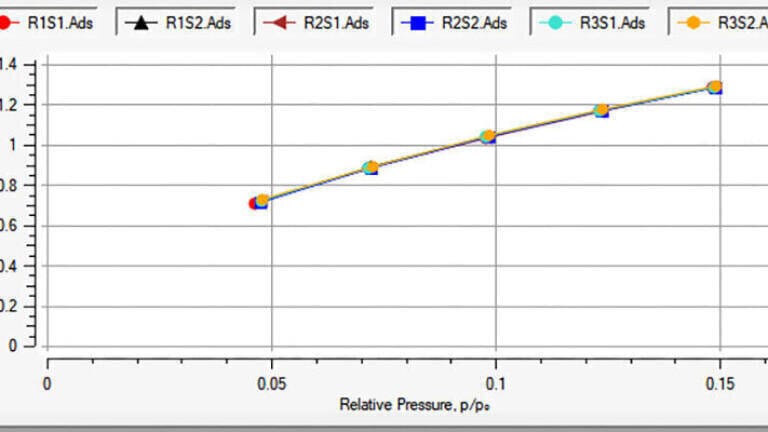
The six total measurements for calcium stearate are overlaid in Figure 1. The BET specific surface area (SSA) calculated for each of the two aliquots analysed in triplicate for calcium stearate are given in Table 2. The results for surface area ranged from 6.262 m2/g to 6.289 m2/g all with correlation coefficients > 0.998. In addition, according to the BET estimation, the C constant and intercept have positive values, confirming that the data are valid and in line with BET requirements.
The six total measurements for zinc stearate are overlaid in Figure 2. In the case of zinc stearate, the surface area values for all data sets ranged from 5.047 m2/g to 5.098 m2/g and all data were within specification with positive values for the C constant and intercept. Because BET is a linear equation, Y = mX + b, a high correlation coefficient (linearity) is desirable. For zinc stearate, the correlation coefficient values were all > 0.999.
Figure 1: Overlay of calcium stearate isotherms
Figure 2: Overlay of zinc stearate isotherms
For the calcium stearate, the sample amount in the sample cells was 1.05 g and 1.25 g, which is approximately 6 m2 of total area in the cell (well over our recommendation of at least 2 m2 of material for surface area evaluation). Reproducibility was calculated at 0.18 %. Analysis time averaged approximately 36.5 minutes for two simultaneous stations collecting five points each under ‘Helium Measure Void Volume’.
Table 2: Calcium stearate BET SSA results
Sample BET SSA (m2/g) Correlation coefficient C constant
Sample 1 run1 6.264 0.99899 17.5997
Sample 1 run 2 6.262 0.99908 17.5105
Sample 1 run 3 6.289 0.99940 17.4071
Sample 2 run1 6.287 0.99926 17.4003
Sample 2 run 2 6.278 0.99932 17.3976
Sample 2 run 3 6.279 0.99917 17.7146
Average 6.2765
Standard deviation 0.011327
Reproducibility 0.18 %
For the zinc stearate, the sample amount in the sample cells was 0.53 g and 0.55 g, which is approximately 2.7 m2 of total area in the cell. Reproducibility was calculated at 0.41%. Analysis time averaged 34 minutes for two simultaneous five-point isotherms.
Data were collected and processed using Kaomi for Nova 21 CFR Part 11 software (optional for industries requiring data integrity and full audit trail). The report (Figure 3) is customisable so a user can select specific graphs, tables, or a summary of results. Here, a template from the software specifically for BET analysis was used.
Table 3: Zinc stearate BET SSA results.
Sample BET SSA (m2/g) Correlation coefficient C constant
Sample 1, run 1 5.061 0.99962 27.3836
Sample 1, run 2 5.071 0.9997 27.7068
Sample 1, run 3 5.047 0.99967 27.3735
Sample 2, run 1 5.092 0.99979 27.2475
Sample 2, run 2 5.094 0.99954 27.133
Sample 2, run 3 5.098 0.99981 27.0874
Average 5.077
Standard deviation 0.020721
Reproducibility 0.41 %
Figure 3: Results report generated with Kaomi for Nova 21 CFR Part 11 software
Great reproducibility of surface area measurement results can be achieved with the Nova 600 when there is enough material in the sample cell for smooth data with minimal noise. Contributions to reproducibility may also come from sample homogeneity. In this study, only two aliquots of each stearate were prepared. However, based on the reproducibility percentage (well under 0.5%) the material is likely to be homogeneous. The results align with the instrument specification of better than 2% reproducibility.
The instrument’s built-in capability to provide CFR compliance enables a user to submit data for revision and for a supervisor to review and approve the reports (refer to Figure 3) using the two-step signature feature. Also, each report includes the relevant audit trail to the specific analysis (different from the full audit trail) for pre- and post-analysis operations. Date- and time-stamps for each operation performed, together with operator, demonstrate compliance with CFR Part 11.
1. Goldstab Organics Pvt. Ltd. Metallic Stearates: Harnessing The Benefits And A Key To Efficiency. [Online] [Cited: Jan 14, 2025.] https://www.goldstab.com/articles/metallic-stearatesharnessing-the-benefits-and-a-key-to-efficiency.
2. MarketsandMarkets Research Pvt Ltd. Metallic. Stearates Market by Type (Magnesium Stearates, Zinc. Stearates, Calcium Stearates), End-Use Industry (Polymer & Rubber, Pharmaceuticals & Cosmetics, Building and Construction), & Region (APAC, North America, Europe, RoW) - Global Forecast to 2028. Markets and Markets. [Online] Oct 20, 2024. [Cited: Jan 14, 2025.] https://www.marketsandmarkets.com/MarketReports/metallic-stearates-market-157185802.html.
3. United States Food and Drug Administration. Part 11, Electronic Records; Electronic Signatures - Scope and Application - Guidance for Industry. Regulatory Information. [Online] Sept 2003. [Cited: Jan 15, 2025.] https://www.fda.gov/regulatory-information/search-fdaguidance-documents/part-11-electronic-recordselectronic-signatures-scope-and-application.
ILM 51.6 Sept 2026




 Product directory














.jpg)



.jpg)

.jpg)
.jpg)
.jpg)
.jpg)