Chromatography
Published over 6 years ago. See the latest and most current information on Chromatography.
Testa Analytical Solutions eK reports that Dynamic Light Scattering (DLS) can be used as an effective analytical technique for analysing virus particles in solution.
A new application report examines four fish viruses incubated under laboratory culture conditions that have the potential to wreak significant economic damage to both recreational and commercially important fish populations.
Traditional visual methods of observing virus particles in solution give a snapshot of only a very small and potentially unrepresentative sampling volume. By comparison, the technique of particle analysis using dynamic light scattering yields an ensemble average of particles present in these solutions. Data presented in the report is from DLS measurements made on a NanoBrook ZetaPALS instrument equipped with a BI-MAS accessory to provide particle sizing capability.
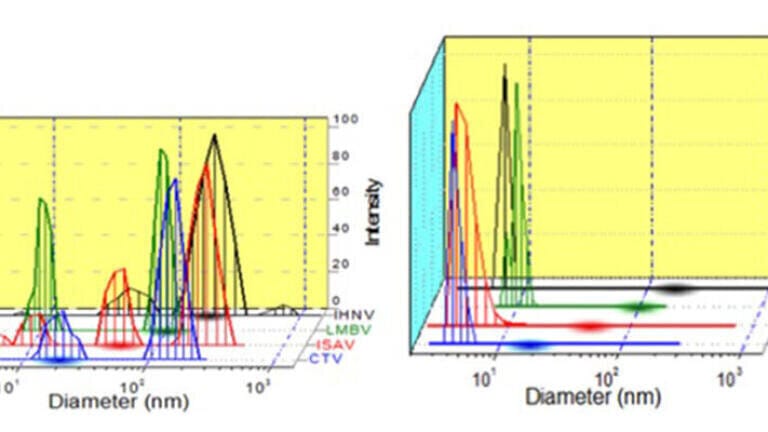
The authors discuss how analysing virus particles incubated in the laboratory present a challenge, as they must be grown within cells in a media containing albumin and other small proteins, such as those present in Fetal Bovine Serum (FBS) solution. When virus particles are released from the cells, the cell fragments are large and can be separated by centrifugation, but the smaller proteins of the media cannot be removed. Careful selection of the distribution parameters from a dynamic light scattering experiment allows the size distributions of virus particles to be clearly observed in the presence of much smaller proteins that constitute the media.
The results presented in the applications report clearly show the presence of virus particles with the expected average dimensions when observed by an intensity weighted distribution. However the absence of these particles in the number distribution shows the virus particles are present in relatively small numbers compared to the proteins and other small molecules in cell growth media.
The Nanobrook ZetaPALS from Testa Analytical provides a platform for zeta potential determination of nanoparticles and colloids in water with salt concentrations less than 75 millimolar ionic strength. The instrument is designed to eliminate the shortcomings inherent in other zeta potential instruments.
For a copy of the application report click here.
More information online
ILM 51.6 Sept 2026


 Product directory


.jpg)
.jpg)


















.jpg)
