Fume extractors
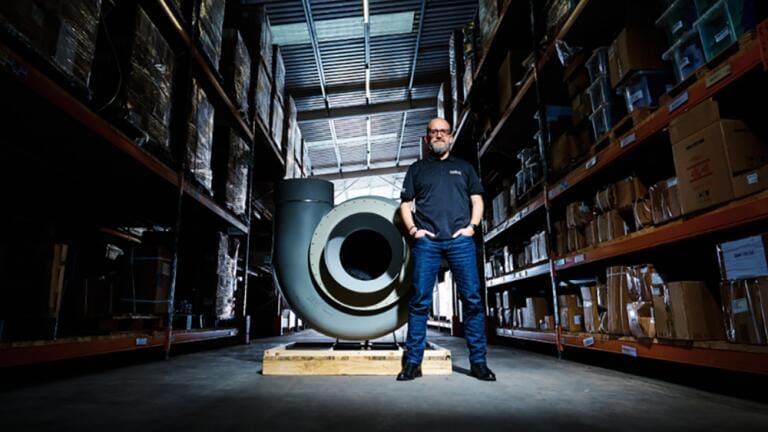
Most fume extraction specifications get the motor right and miss the fan body entirely. In an ATEX Zone 2 environment, that gap matters. Here's what Ex h actually means on a polypropylene fan, why carbon loading exists, and what it should mean for your next laboratory extraction project.
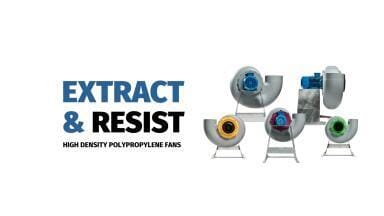
Polypropylene has long been the material of choice for corrosion-resistant fan housings in laboratory, chemical and corrosive fume extraction. Its resistance across a broad range of aggressive media, acids, alkalis, solvent vapours, makes it a reliable foundation for extraction systems where metal or steel alternatives would simply degrade. The question for contractors and specifiers working in potentially explosive environments is how that corrosion-resistant platform gets extended to meet ATEX requirements, and what that actually means in practice.
The answer lies in understanding what makes polypropylene problematic in hazardous atmospheres in the first place. Commercial polymers are, by their nature, electrical insulators. Without modification, charges deposited on a polymer surface have a long decay time. They sit there, building up, and the longer they persist, the greater the risk of an electrostatic discharge event. In a Zone 2 environment where flammable vapours or gases are present, that discharge can be enough to act as an ignition source. The fan itself, not the motor, not the control gear, but the fan body, becomes the risk.
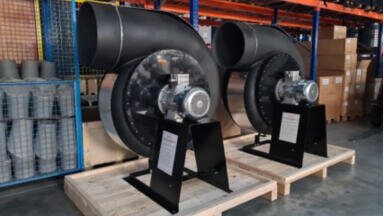
ATEX certification for a polypropylene fan addresses precisely this. The Ex h marking on a non-electrical component signals that the fan housing has been manufactured in a way that removes it from consideration as a potential ignition source. The mechanism for achieving this is carbon loading, the incorporation of carbon black particles into the polymer matrix during manufacturing. Carbon black, produced by burning hydrocarbons in a limited oxygen environment, introduces a branched conductive structure into the polypropylene that allows electrons to flow and static charge to dissipate rather than accumulate.
The physics behind it comes down to two properties, resistivity, which describes how strongly a material resists electrical current, and dielectric permittivity, which governs its ability to store charge under voltage. Reducing both, which carbon loading achieves, shortens the charge decay time and moves the material from insulator to static dissipative. Where airflow passes across fan blades and friction generates surface charges, that dissipation is what prevents a discharge event.
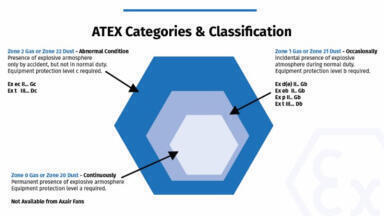
For specifiers, the practical implication is straightforward. A standard polypropylene fan and an ATEX polypropylene fan may look identical and handle identical corrosive duties, but only one of them belongs in a Zone 2 classified space. In environments where IIC hydrogen gas could accumulate, the distinction isn't academic, hydrogen sits at the most demanding end of the gas group classifications for a reason.
The SA and STA ranges cover a wide performance from under 500 m³/h to beyond 14,000 m³/h, with discharge handing adjustable in 45-degree increments to suit installations. Both metal and weather-protecting box pedestal configurations are available across the range.
Full performance data, dimensional drawings, and electrical specifications for the complete ATEX polypropylene range are available to download. If you're working on a project that requires corrosion-resistant fans in a hazardous area classification, the Axair team are available to support.
ILM 51.6 Sept 2026



 Product directory


.jpg)