Pipettes
Published over 8 years ago. See the latest and most current information on Pipettes.
Handling of volumes in the mL range of highly viscous liquids such as 99% glycerol, detergents or collagen in the laboratory and for analytical purposes has proven difficult, requiring the use of suboptimal tools such as spoons. These requirements cause tremendous delays to analysis and mixing procedures. As such, the precise volume of the liquid must frequently be determined via several material-intensive steps: in an initial time-consuming step, the highly viscous liquids are transferred between different vessels, followed by weighing and calculating the volume by consulting the liquid’s specific density.
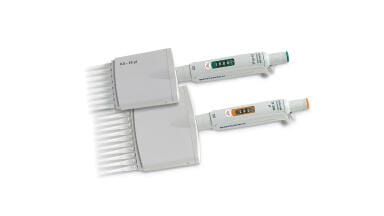
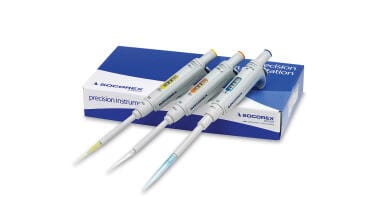
In order to process aqueous liquids in precisely, modern laboratories also use pipettes with different functional principles, each equipped with the respective consumable tips. For viscous liquids in particular, those pipettes that function according to the direct displacement principle, similar to that of a syringe, have prevailed. However, increasing viscosity leads to growing flow resistance inside the tip. The consequence: either the hand strength of the operator, the material comprising the operational controls or the motors of electronic pipettes will reach their limit. Additionally, the processing speed will decrease with increasing viscosity, particularly if precision is of the essence. Up to now, the limit of the dynamic viscosity, which is dependent on the capacity of the pipetting system or the operator, respectively, consistently ranged between approximately 200 and 300 mPa*s (10 mL tip volume). This is roughly equivalent to the viscosity of 86% glycerol at 20°C.
A new invention by the company Eppendorf, which has been developing Liquid Handling Instruments for the past 57 years, is about to dissolve this limit. The new ViscoTip® for the associated Multipette instrument is purportedly capable of processing tough liquids such as collagen with viscosities of up to 14,000 mPa*s precisely and quickly. It was introduced to the public for the first time in April 2018 at the analytica exhibition.
Click here for additional information, including information on the liquids tested.
ILM 51.6 Sept 2026





 Product directory