Laboratory products
Automated rheology measurements provide 24/7 operation and hours of walkaway time thanks to unsupervised handling of large numbers of samples. On top of efficiency gains, they ensure the highest data quality, improve repeatability and consistency in results, provide full traceability, and enhance safety by reducing exposure to hazardous substances.
Automated rheology measurements are applicable to a wide range of samples, including food, personal care products, fragrance and flavour products, paints, and chemical industry products. In all of these industries, lab automation is essential. It boosts productivity by accelerating routine tasks, allowing scientists to focus on complex work, and accelerates innovation with high-throughput testing and rapid data analysis.
Automation doesn’t just cover the measurement itself. Advanced systems also deliver automation of associated tasks such as pH measurements or the cleaning of measurement geometries, ensuring resources are focused on adding value.
Here’s a closer look at some of the benefits of automation:
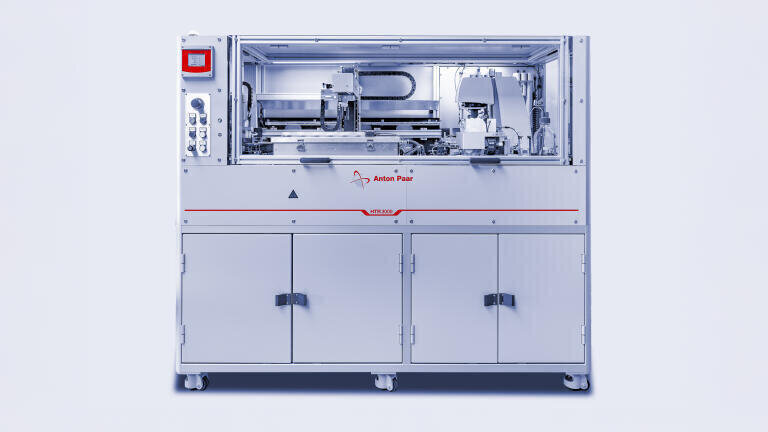
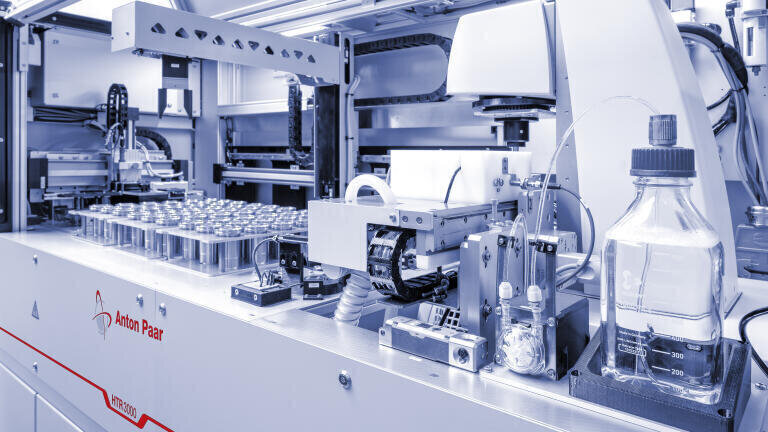
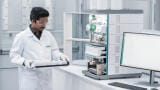
The HTR 3000 automated rheometer performs fully automated rheological measurements with Anton Paar’s MCR 102e or MCR 302e benchtop rheometers. HTR 3000 processes up to 250 samples per day, eliminates five manual steps, and frees up hours of walkaway time. Optional features such as a pH station, barcode scanner, automated cleaning function, and advanced safety features complement its capabilities.
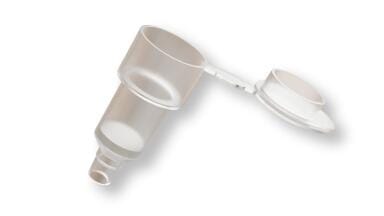
With a storage capacity of up to 54 cups, users are free to focus on other tasks. The integrity and reliability of samples are ensured at every step of the process, even where temperature conditioning is required (e.g., food products). Optional features such as gravity caps, a waste unit, a temperature-controlled rack, and a priority drawer make the HTR 3000 highly adaptable to customer requirements.
Compared to manual measurement, HTR 3000 offers greater safety, higher precision, and increased throughput – key advantages for R&D tasks and quality control in modern labs
ILM 51.6 Sept 2026



 Product directory













.jpg)
.jpg)
.jpg)