Laboratory products
Drying cabinets are familiar, versatile and suitable for many laboratory loads. But if most of what you are drying consists of flasks, measuring cylinders, test tubes and other narrow-necked vessels, heating an entire cabinet may not be the quickest or most efficient way to get the job done.
The problem is airflow. A conventional cabinet heats the space surrounding the glassware, but that warm air does not necessarily circulate effectively inside an inverted flask or cylinder. The outside may appear dry while droplets remain trapped on the internal surfaces. What should be a simple final step can therefore become an unexpected laboratory bottleneck.
Natural air drying takes even longer, leaving wet glassware occupying draining racks and worktops while the laboratory waits for it to become usable again.
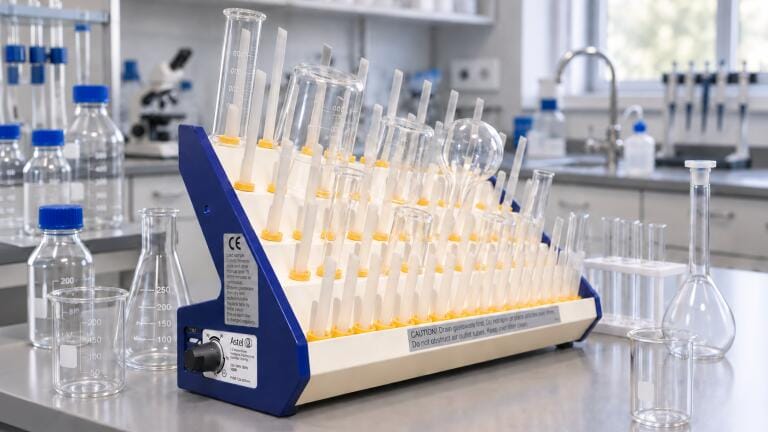
Instead of heating a cabinet and waiting for warm air to find its way into each item, the Nelldorn Glassware Dryer directs thermostatically controlled warm air through individual drying tubes and into the inverted glassware.
This brings the airflow into direct contact with the wet internal surfaces, accelerating evaporation where it is most needed. Most items can be dried in approximately 15 to 20 minutes, with capacity for as many as 60 pieces at once.
Different tube lengths accommodate commonly used laboratory items including volumetric flasks, measuring cylinders, test tubes, beakers and other containers. Suitable plasticware can also be dried, provided its temperature limitations are observed.
Once dry, equipment can remain on the tubes until it is required, allowing the dryer to double as an organised temporary storage rack.
A conventional drying cabinet can consume a considerable amount of valuable bench or floor space. The Nelldorn measures just 490 mm wide, 430 mm high and 190 mm deep, and can either stand on a workbench or be mounted on a wall.
Its stepped arrangement allows individual items to be removed without disturbing the remainder of the load. It also encourages water to run towards a small drainage outlet rather than collecting around the base of the unit.
An adjustable timer switches the dryer off automatically after a selected period of up to 120 minutes. Combined with targeted airflow, this provides a more focused alternative to operating a larger heated cabinet for relatively small items.
Washing or sterilising laboratory glassware is only part of its journey back into use. If drying remains slow and uncontrolled, it can undermine the efficiency gained elsewhere in the process.
That does not mean every drying cabinet is wrong. Cabinets remain useful for large, mixed or awkwardly shaped equipment. But for laboratories regularly processing batches of narrow-necked glassware, it is worth asking whether warm air is being directed where it can do the most work.
As Astell Scientific explains in “Every laboratory needs a Nelldorn Glassware Dryer!”, changing the way glassware is dried can reduce waiting, free workspace and return frequently used equipment to the laboratory faster.
ILM 51.6 Sept 2026


 Product directory


.jpg)
.jpg)










.jpg)
.jpg)
.jpg)