Laboratory products
Published over 16 years ago. See the latest and most current information on Laboratory products.
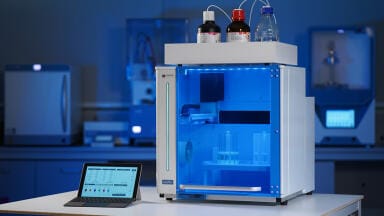
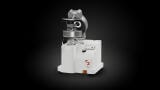
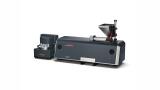
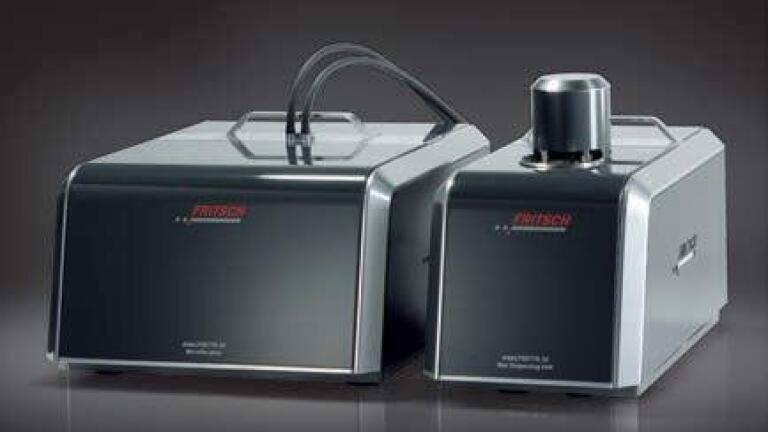
When determining particle sizes a wide variety of techniques are used in which sieving may be the most popular. Sieving is a relatively simple technique, despite the fact that of course different instrumental approaches can be used. On the other hand, sieving is very time consuming and yields results only for a very limited number of particle sizes. All these and some others limit the accuracy and precision of sieve analysis and are reasons for this technology being widely replaced by light scattering methods - Fritsch ANALYSETTE 22 MicroTec plus Laser Particle Sizer, especially for sizing particles smaller than a few millimetres.
Static laser light scattering can be utilised to cover a particle measuring range from approximately ten or twenty nanometers up to a few millimetres. When a laser beam illuminates a particle, light scattering is observed and from the angular intensity distribution detected behind this scattering event, the particle size can be calculated. Therefore, laser light scattering is an indirect method of particle size measuring, just like many other techniques where some specific physical properties are measured; from the obtained values the particle size is then calculated.
When a large number of particles are packed together, in most cases some of the particles will stick together forming so called agglomerates. In general two different classes of dispersion are available: wet dispersion and dry dispersion.
Some materials can hardly be measured in liquid. In those cases the dry measurement is a real alternative. Here the material is accelerated in an air stream through a so-called Venturi nozzle and expands rapidly behind the nozzle, where the highly turbulent stream rotates the agglomerates quickly and they collide with other agglomerates and particles. Due to these interactions, the agglomerates fall apart and single particles can be measured. However, compared to the introduction of ultrasound in water, this process is much less effective.
ILM 51.6 Sept 2026



 Product directory