Laboratory products
Published over 10 years ago. See the latest and most current information on Laboratory products.
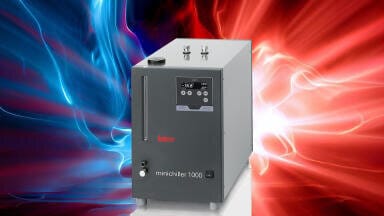
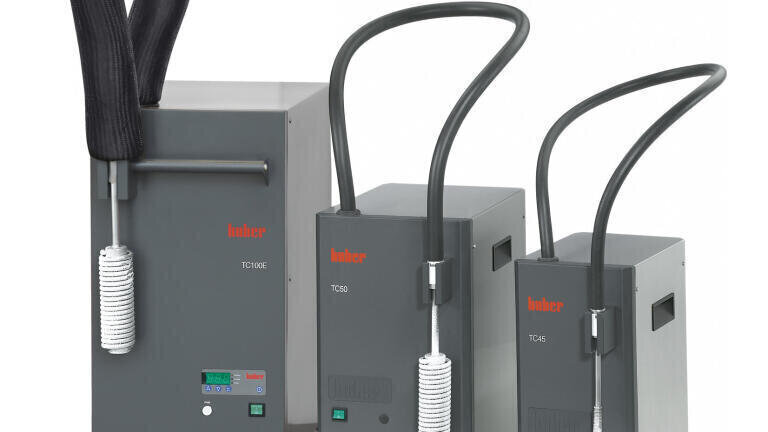
With their range of Immersion Coolers, Huber Kältemaschinenbau offers a flexible solution for a variety of cooling applications. These units are easy to use and ideally suited to quick liquid cooling. A typical application is to cool heating thermostats or as a substitute for dry ice. Immersion coolers offer an environmentally friendly cooling alternative by reducing consumption of tap water.
The TC Immersion Coolers are available without a controller for continuous cooling or respectively with controller and Pt100 sensor connection. Models with the addition ‘E’ are equipped with a LED Display for set-point indication and have a temperature stability of ±0.5 K. All models come with the option of a coil or flexible evaporator, made of stainless steel for cooling liquids in nearly all vessels.
The range consists of three main models with cooling capacities up to 300 watts for working temperatures from -100°C to +100°C (depending on the model). Small footprints combined with compact housing made from high quality stainless steel and carrying handles allow the Immersion coolers to be easily positioned for use and, for easy relocation, trolleys are available as accessory.
More information on www.huber-online.com or in the current catalogue.
ILM 51.6 Sept 2026




 Product directory