News
University of Bonn professor will receive approximately €1.5 million over five years to examine how the human brain constructs a first-person representation of its surroundings
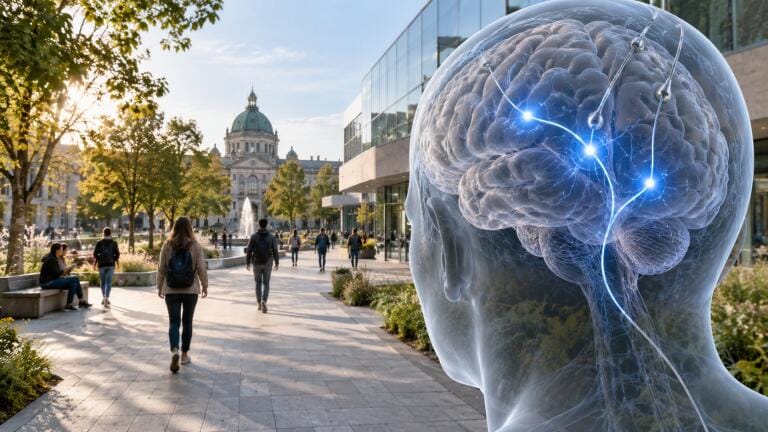
Professor Lukas Kunz, who is also affiliated with University of Bonn (UB) Hospital, will investigate how the brain constructs its representations of the world, specifically how nerve-cell activity allows people to perceive and navigate the world from a first-person perspective. The ERC will provide approximately €1.5 million across five years for the researcher. The ERC’s Starting Grants programme supports promising early-career researchers who have demonstrated the potential to establish independent research programmes.
Kunz, from the department of epileptology at University Hospital Bonn, Germany, will study how the brain represents the positions of people, objects, landmarks and goals in relation to a person’s own body.
His project, called: ‘Making sense of space: Uncovering the roles of egocentric neurons for spatial behaviour in humans’, will use the acronym NEUROSPACE. It will focus on specialised nerve cells known as ‘egocentric neurons’ which may help the brain to construct a self-centred internal map of the surrounding environment.
“We believe that specialised nerve cells in the brain, known as egocentric neurons, play a key role in this process,” Kunz said.
“Our hypothesis is that these cells represent the position of other people, objects, landmarks and goals relative to our own body. In this way, they may create an internal map of our surroundings centred on ourselves,” he added.
To test the hypothesis, Kunz and his team will measure the activity of individual nerve cells in patients with epilepsy who already have electrodes implanted in their brains for other clinical purposes.
Physicians sometimes use implanted electrodes to determine the source of seizures when non-invasive diagnostic techniques will not provide sufficient information. The presence of these electrodes also offers researchers the rare opportunity to measure the electrical activity of individual neurons in a living human brain.
Participants will complete a series of tasks in physical and virtual environments. The experiments will allow the researchers to assess how egocentric neurons contribute to perception, spatial orientation, navigation, memory and the comprehension of spatial language.
Through measurements from individual neurons during controlled tasks, the team hopes to connect specific patterns of cellular activity with aspects of human thought and behaviour. This approach could provide evidence that standard non-invasive brain-imaging methods cannot readily obtain because such techniques generally measure the combined activity of much larger populations of cells.
The research could also add to the knowledge base around the spatial and memory problems associated with a variety of neurological disorders. People with epilepsy, Alzheimer’s disease and other conditions can experience difficulties with orientation, navigation and the recognition of spatial relationships.
“The findings could help us to understand disorders of spatial orientation and memory that occur in epilepsy, Alzheimer’s disease and other conditions. They could potentially provide a basis for novel diagnostic and therapeutic approaches,” Kunz explained.
Kunz is a member of the UB’s Transdisciplinary Research Area ‘Life and Health’. The university established its Transdisciplinary Research Areas to unite researchers from different academic fields to address complex scientific and societal questions.
He has also served as Professor of Cognitive and Translational Neuroscience at UB since 2023 and leads a research group within the department of epileptology at the University Hospital.
Kunz studied medicine, philosophy and German studies at UB. He later received doctorates in medicine and biology from both the universities of Bonn and Freiburg. From 2018 to 2023, he held postdoctoral positions at University Medical Center Freiburg and Columbia University in New York, USA.
ILM 51.6 Sept 2026



 Product directory
























.jpg)
