Laboratory products
Published over 14 years ago. See the latest and most current information on Laboratory products.
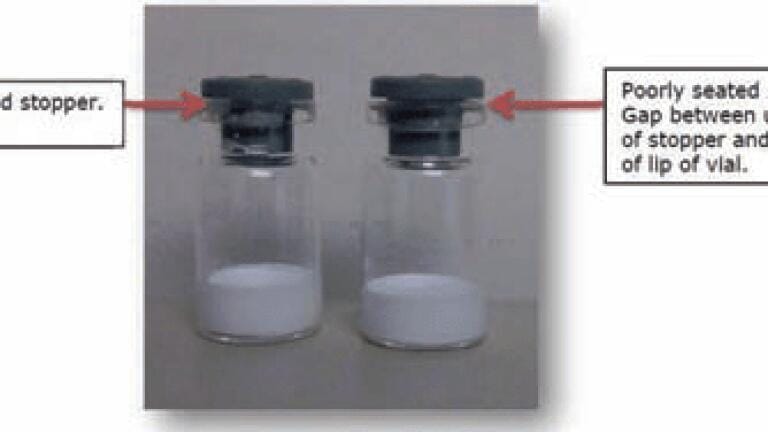
SP Scientific has released an informative new technical brief, which discusses freeze dryer equipment and the considerations and alterations that may be required based on container-closure selection. Today many vials are stoppered by freeze dryers at sub-atmospheric pressure, with or without an inert gas layer over the product. As the internal vial environment is at a lower pressure than its surrounds, an improperly seated stopper can easily lead to the ambient atmosphere leaking into the stoppered vial. This may lead to oxidation damage or re-absorption of
moisture, decreasing product shelf life and quality.
As a supplier of Production and Research & Development freeze dryers for over 30 years, SP Scientific has encountered a wide spectrum of freeze dryer vial container-closure systems. As dosages and containers have decreased in size, a growing number of freeze dryer systems are increasingly challenged to properly
seat the stopper into the glass vial because this configuration typically requires more force per square inch than previously used container closure systems. In addition, SP Scientific has found that vials for R&D are not always processed as they are in a production environment and this may create a significant impediment to properly seating the stopper due to an incorrect processing of vials.This new technical brief, downloadable from the SP Scientific website, presents protocols and straightforward calculations to enable you to determine the force required for your freeze dryer to securely seat the stopper in the vial of your choice, while eliminating the use of excess pressure that may crush vials or warp shelf assemblies.
ILM 51.6 Sept 2026



 Product directory