.jpg)
Laboratory products
Published over 5 years ago. See the latest and most current information on Laboratory products.
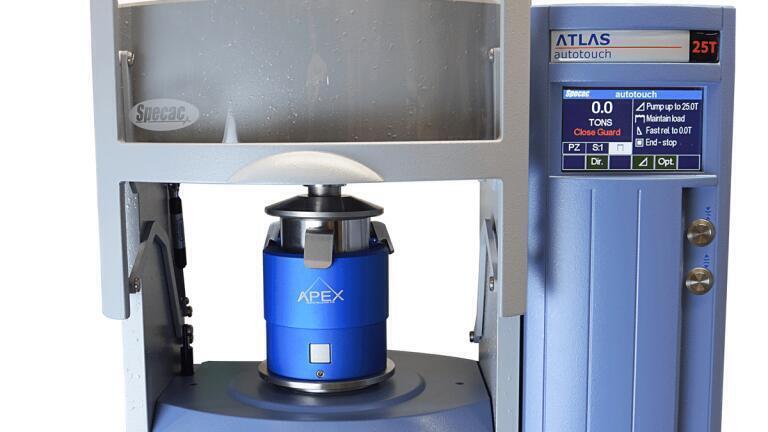
For both high and low sample volume, Apex is one the most flexible tools to press pellets for XRF spectrometry, not only it is fast and flexible, but also space and cost saving (when used alongside our Autotouch range of presses).
When speed is important
Some laboratories will be carrying non-stop QA/QC over raw meal, production line and final product, thus high number of analysis must be done, Autotouch and Apex give these analysts the speed required by delivering a pellet in 2 minutes. If speed is not a priority, Autotouch and Apex can still produce samples conveniently and reliably due to its unique semi-automatic design that needs no user intervention during the pressing cycle, reducing human error and improving repeatability.
Why pressing pellets in the first place?
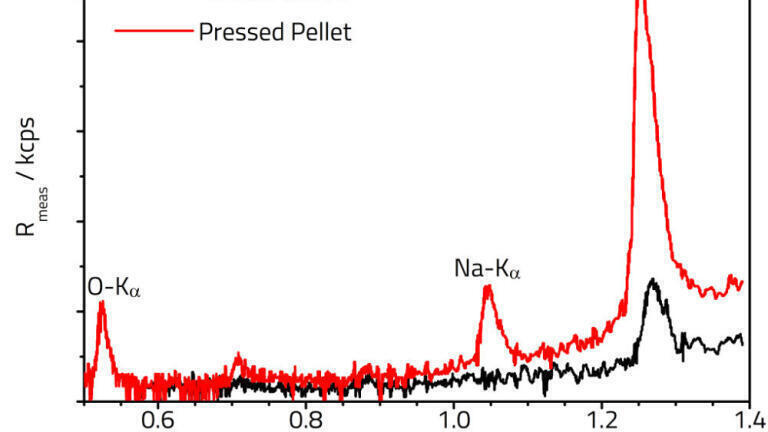
Particle size, mineral composition, or density can all affect the intensity of the characteristic emission peaks and increase background scattering. These effects rule out reliable quantification of sample composition. Therefore, reducing these factor yields cleaner spectra and better results.
The most common technique to prepare samples in XRF, used both in industry and research settings, involves grinding sample powders to a fine particle size and pressing them into a smooth, flat pellet, often with the help of binders to aid the adhesion within the powder.
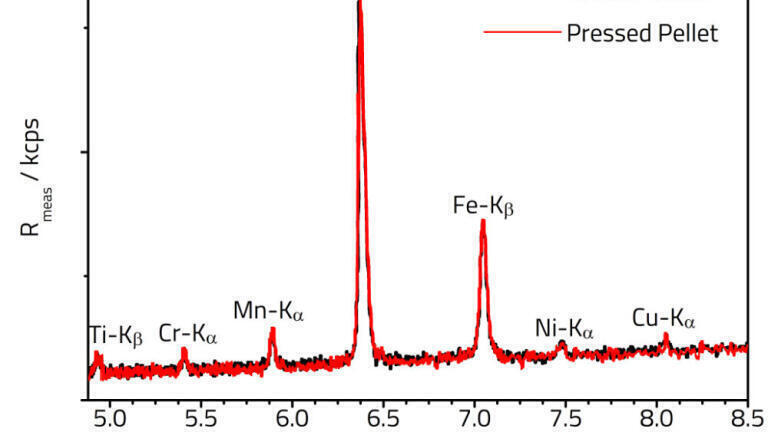
The benefits of pressing powders can easily be seen across the lower weight elements in the periodic table, common metals such as Na, K and Mg are very sensitive to the effect mentioned above. So how a spectra of a powder with and without pressing looks like for these elements?
On the other hand, if the elements of interest are only higher atomic weight, then both techniques become almost identical, however, depending on the spectrometer, count rate and sample characteristics, accuracy can still be impacted.
More often is the case that analysts would like to quantify lower atomic weights elements in industries such as cement, mining, food, to mention some.
ILM 51.6 Sept 2026



 Product directory


.jpg)
.jpg)










.jpg)
.jpg)
.jpg)