Laboratory products
Published over 15 years ago. See the latest and most current information on Laboratory products.
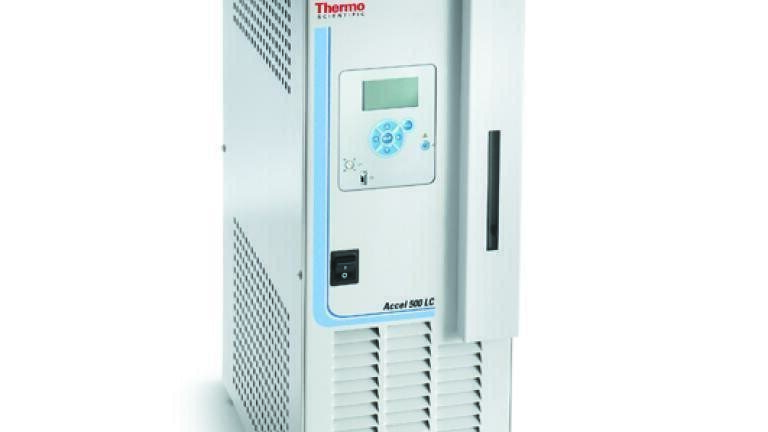
Thermo Fisher Scientific, Inc has launched the new Thermo Scientific Polar Series thermostatic laboratory chillers, the Accel 250 and Accel 500. The Polar Series has a temperature range from -10 to 80°C, allowing users to select the optimal set-point for each application. Thermostatic technology enables fast temperature ramping, and this delivers immediate heating and cooling for an extremely efficient workflow. Furthermore, the energy-saving mode in the Series makes it an environmentally friendly option for any laboratory requiring precise temperature control. The Polar Series is ideal for an expansive range of applications, including chemical reaction control, separations, spectroscopy and surface science.
These easy-to-use laboratory chillers are programmable via an intuitive user interface, making it simple to set required temperature parameters. A compact footprint and minimal noise enable convenient in-lab placement, increasing laboratory efficiency. An internal reservoir and pump and cooling capacity options ensure extremely accurate temperature performance. The integrated fill port, drain and site tube design facilitates quick and easy operation. This range of CE- and CSA-compliant chillers has an intuitive plug and play design, eliminating any lengthy installation processes.
Lab Asia 33.6 Dec



 Product directory