Laboratory products
Published over 15 years ago. See the latest and most current information on Laboratory products.
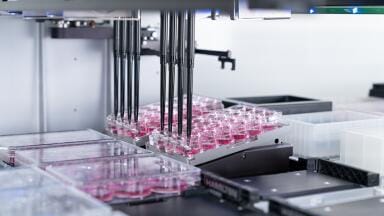
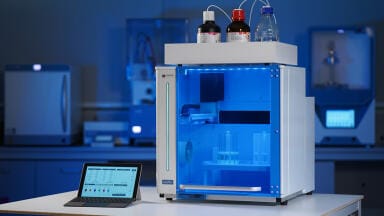
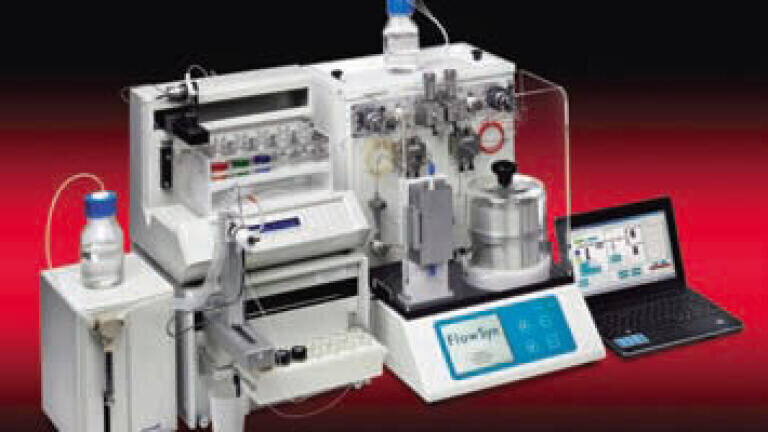
Uniqsis has further enhanced the FlowSyn by launching an automated loop filling module (FlowSyn Auto-LF) that allows flow chemists to perform multiple experiments with multiple reagents automatically. With simultaneous loop filling and fraction collection this highly versatile research tool enables chemists to harness the power of flow to deliver more compounds even faster. Not only can this latest addition to the FlowSyn range of continuous flow reactors be used to prepare focussed combinatorial libraries in Flow, it can also perform automated experiment optimisation and reagent screening.
Derek Lowe of Vertex Pharmaceuticals, USA, commented: “The FlowSyn Auto-LF has given us the flexibility we need to investigate new flow reactions in an automated fashion. We can then turn around and produce arrays of compounds using these chemistries, without a long learning curve.” According to Dr Mark Ladlow, Uniqsis Chief Scientific Officer: “The main focus in developing this system has been to introduce a powerful and highly versatile research tool enabling the chemist to harness the power of Flow Chemistry to deliver compounds more quickly. A serious limitation of existing systems is attributed to the complexity of their user interface. Listening to potential customers we understood the need for a dedicated software interface that is both straightforward and easy to use in an open access environment, and that is what we have delivered.”
One of the main advantages of FlowSyn Auto-LF is that by using a separate liquid handler and fraction collector, sample loop filling for the next experiment can take place before the current experiment has finished, thereby reducing overall runtimes. Additionally, there are no injection ports to leak or block, and the fully integrated robust wash protocols minimise the risk of crosscontamination. Partial filling of loops is allowed so stoichiometry can be varied in subsequent experiments and volumetric accuracy is ensured by sampler calibration to position samples precisely in the loops. Data monitoring is included and the reaction progress can be monitored on the screen in real-time and saved as a log file for each experiment to give an audit trail.
ILM 51.6 Sept 2026



 Product directory