Research news
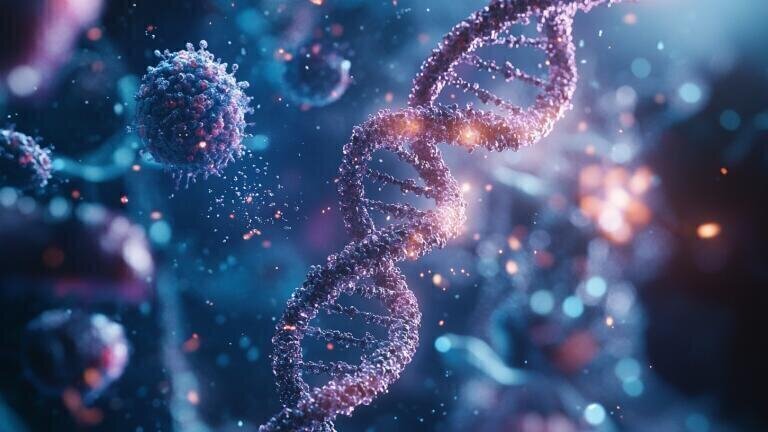
More than half of the mammalian genome consists of remnants of ancient viral DNA known as ‘transposable elements’ ─ sequences of DNA that can change their locations on the genome. Once dismissed as junk, or superceded-code, in the genome, a German research team has now revealed the role they play in early embryo development.
Transposable elements, remnants of ancient viral DNA, are reactivated during the first hours and days following fertilisation. This dynamic phase of early development sees embryonic cells display remarkable plasticity. The molecular mechanisms and factors that regulate this plasticity however remain unclear.
Mouse models suggest that transposable elements play a crucial role in cellular plasticity, but it is still uncertain whether this is a universal feature across all mammalian species. The diverse evolutionary origins of these viral remnants raise further questions about their conservation across mammalian genomes.
Understanding the regulatory mechanisms that govern the activation of transposable elements is essential to advance reproductive medicine and uncover the fundamental principles of genome regulation.
The team drawn from the state-funded research organisation, Helmholtz Munich and the Ludwig-Maximilians-Universität (LMU) ─ both based in Munich, Germany ─ was led by Professor Maria-Elena Torres-Padilla and set out to explore these ancient DNA sequences by developing a novel method to study their transcription.
Creating a single embryo ‘atlas’ to compare embryos between several mammalian species, that included mouse, cow, pig, rabbit ─ and the non-human primate ─ rhesus macaque, their findings were surprising. Researchers discovered that very old viral elements, previously thought to be extinct, are re-expressed in mammalian embryos. They also found that each of the species studied expresses distinct types of these elements.
“This approach offers a novel way to influence cell fate, such as directing stem cell differentiation, which typically requires the simultaneous manipulation of hundreds of genes,” said co-first author Dr. Marlies Oomen.
“Our work highlights the importance of understanding the regulatory principles behind transposable elements,” Dr. Oomen added.
These experimental observations show that the activation of transposable elements is conserved across species, and identifying specific elements provides exciting opportunities to manipulate thousands of genes in cells at the same time.
“Our research uncovered that transposable element activation is a distinctive feature of early embryos in several mammalian species. This finding is significant because these early-stage cells can differentiate into all body cell types,” Professor Torres-Padilla explained further.
“By understanding how these cells regulate ancient viral elements, we gain crucial insights into the mechanisms of cellular plasticity. This study sets the stage for future research into specific regulatory elements, with broad implications for health, disease, and how manipulating these elements could impact cellular processes.”
In addition to developing a novel methodology that opens new avenues for researchers working with single cells and embryos, this study has generated an unprecedented dataset.
Early embryo development is a highly dynamic process that is of great interest to scientists, but most studies tend to focus on a single species, typically mouse or human. This study, however, took an evolutionary approach by comparing multiple mammalian species, allowing the identification of key regulatory pathways shared across mammals.
For further reading please visit: doi.org/10.1016/j.cell.2024.12.013
ILM 51.6 Sept 2026



 Product directory



















,-photo-Karin-Allander.jpg)







.jpg)
