Research news
A research team at the University of Exeter has shown that a finger-prick blood test combined with online cognitive assessment both conducted at home could help identify people at elevated risk of dementia, potentially allowing earlier intervention
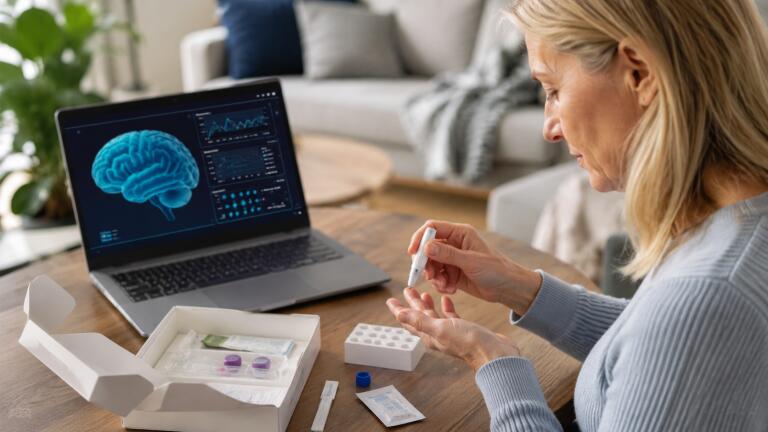
An at-home finger-prick blood test combined with an online cognitive assessment could one day allow clinicians to identify people at increased risk of dementia without the need for specialist visits to clinics, according to a study led by the University of Exeter.
The research has demonstrated that levels of blood proteins associated with dementia correlated with performance on a series of online brain function tests completed at home. The findings have raised the prospect of scalable community-based screening to identify individuals most likely to benefit from further investigation, monitoring, treatment or support.
The study was funded by the National Institute for Health and Care Research (NIHR) Exeter Biomedical Research Centre, a health research partnership that brings together the Royal Devon University Healthcare NHS Foundation Trust and the University of Exeter, with support from the NIHR in the UK.
Researchers said the approach could help address a major challenge in dementia care, where many people with early signs of cognitive decline do not currently receive specialist assessment until symptoms become more advanced. By combining remote blood biomarker analysis with digital cognitive testing, the team suggested that healthcare services may eventually gain a practical method to triage populations at scale according to dementia risk.
The study drew on data from the PROTECT study, an online longitudinal research programme in which more than 30,000 UK-based participants aged more than 40 years complete regular assessments of memory, attention and executive function. Executive function refers to a group of cognitive processes that support planning, decision-making, concentration and behavioural control.
The latest phase of the research involved 174 PROTECT participants who completed the home-testing process independently. Participants received finger-prick blood collection kits by post, administered the test themselves and returned samples to the research team for analysis.
Scientists measured two proteins linked to neurodegenerative disease. One biomarker, phosphorylated tau 217 (Ptau217) has strong associations with Alzheimer's disease pathology. The second biomarker, glial fibrillary acidic protein (GFAP) is associated with broader neuroinflammatory processes and brain tissue damage linked to cognitive decline.
The team found that higher concentrations of these biomarkers correlated with poorer performance on online cognitive tests, with Ptau217 showing the strongest association. Researchers subsequently used the combined data to classify participants into low, moderate and high-risk categories for future dementia development.
“Our previous research has shown that a finger-prick blood test can effectively be taken at home and posted to labs, and that we can identify the biomarkers in blood linked to dementia,” said Professor Anne Corbett of the University of Exeter Medical School, who led the study.
“This novel study builds on that to show that we can link these biomarkers with performance on brain tests, giving us a potential way to predict risk of dementia,” she said.
Dementia remains one of the most significant public health challenges in the UK. According to current estimates, almost one million people across the country live with the condition, with numbers expected to rise as the population ages. Researchers have increasingly focused on methods to detect neurodegenerative disease earlier, particularly as disease-modifying therapies emerge that may prove most effective before extensive brain damage occurs.
“This work raises the potential for screening people for their risk without the need for clinic visits or complex clinical assessments,” Professor Corbett said.
“It would ensure the people at highest risk could be prioritised for monitoring and diagnosis, unlocking the best support and treatment for those that need it most,” she added.
The Exeter team argue that a remote screening model could help reduce pressure on health services while widening access to early assessment. Current diagnostic pathways often require specialist referral, brain imaging and extensive clinical evaluation, all of which can delay diagnosis and restrict access for people with subtle early symptoms.
“Almost a million people in the UK are estimated to have dementia, yet at the moment, only one in a thousand people with the earliest signs of brain decline receives a specialist evaluation,” said Professor Clive Ballard of the University of Exeter Medical School, who contributed to the study.
“Our approach of combining our robust cognitive testing with measuring proteins via a postal blood test could provide a straightforward, efficient and cost-effective method to reach large numbers of people in the community who would not otherwise be prioritised for the next steps of diagnosis or support and to optimise the clinical pathway to enable early detection of those at highest risk.
“We need further research to validate this approach, and I’d encourage anyone aged 40 or more to join us by signing up to PROTECT,” Professor Ballard added.
The findings have also attracted support from senior figures within the NIHR, who highlighted the potential implications for the UK’s National Health Service (NHS).
“The potential of this combination of cognitive and blood tests – both of which can be done at home – is really exciting,” said Professor Marian Knight, scientific director for NIHR Infrastructure.
“Not only could it reduce the burden on the NHS by screening people in their own homes rather than in hospitals or clinics, but it also might mean we can identify people with dementia earlier, tailor treatments more effectively, and improve outcomes for patients.
“This is a fantastic example of research teams in NIHR infrastructure working together to deliver real change for the public and the NHS, in line with government priorities,” Knight added.
Participants involved in the PROTECT study also described the personal motivations behind their involvement in dementia research. Exeter resident Vic Owens, aged 46, joined the programme after witnessing the effects of Alzheimer’s disease within his extended family.
“Sadly, my ex’s mother passed away from Alzheimer’s disease, which really brought the issue close to home,” said Owens, who works in fundraising.
“Seeing that decline is so scary, and you feel really helpless. When I heard about the PROTECT study, I wanted to understand more about what can help keep my brain sharp and also contribute to something that could help other people.
“It’s really easy to take part from home – it’s just like doing fun brain training games.
“I feel part of something useful, and it’s great to see findings like this which could help provide an economic way to screen people from their own homes and identify those at risk so they could get the help they need,” Owens added.
For further reading please visit: 10.1038/s41467-026-71448-2
ILM 51.6 Sept 2026



 Product directory




















,-photo-Karin-Allander.jpg)








.jpg)
