Research news
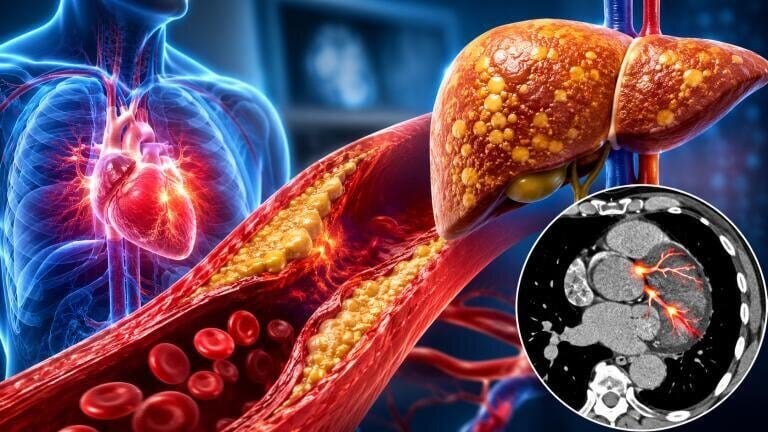
Mass General Brigham researchers have found that hepatic steatosis, commonly known as fatty liver disease, was associated with more non-calcified coronary plaque and a higher rate of cardiovascular events among patients assessed for chest pain
Researchers at the Mass General Brigham Heart and Vascular Institute, Boston, USA, have found that people with hepatic steatosis – commonly called ‘fatty liver disease’ – had a higher amount of non-calcified, rupture-prone coronary plaque and experienced nearly twice the rate of cardiovascular events compared with people without steatosis.
The findings suggest that cardiac computed tomography (CT) scans could provide an opportunity to identify patients who may benefit from more intensive cardiovascular prevention strategies. CT is routinely used to assess patients with suspected coronary artery disease and can also capture part of the liver within the scan field which means signs of hepatic steatosis may be visible during cardiac imaging performed for chest pain.
“Our findings highlight that fatty liver disease is not only a liver condition but also an important marker of heart disease risk,” said Dr. Jan Brendel, lead author of the study and a postdoctoral research fellow in the Cardiovascular Imaging Research Center at the Mass General Brigham Heart and Vascular Institute.
“Fatty liver disease can be detected on routine cardiac CT scans and could help guide earlier, preventive treatment,” he said.
Hepatic steatosis occurs when excess fat accumulates in the liver. The condition is common and has been associated with metabolic risk factors such as obesity, insulin resistance, type 2 diabetes and dyslipidaemia. The novel study examined whether hepatic steatosis was also associated with the type and volume of plaque found in the coronary arteries, particularly non-calcified plaque. This softer plaque type is considered clinically important because it is more likely to rupture than calcified plaque and may trigger a clot that can block blood flow to the heart.
To investigate the association between hepatic steatosis and cardiovascular health, the researchers analysed data from 3,637 participants in the PROMISE trial, a large multicentre study of patients evaluated for chest pain. Using cardiac CT scans, the team measured coronary plaque volume and plaque composition, while also assessing hepatic steatosis because portions of the liver were often visible in the images. The CT results showed that just more than 25 per cent of participants had hepatic steatosis.
The imaging analysis revealed that patients with hepatic steatosis had a 24 per cent increase in non-calcified plaque volume and a 15 per cent increase in total and non-calcified plaque burden compared with people who did not have hepatic steatosis. These findings indicate that fatty liver disease may be associated not only with the presence of coronary plaque but also with plaque features that are more likely to contribute to acute cardiovascular events.
During a median follow-up period of 25 months, patients with hepatic steatosis were more likely to experience major adverse cardiovascular events, including death, heart attack or hospital admission for unstable angina, compared with those without steatosis. The event rate was 4.1 per cent among patients with hepatic steatosis and 2.5 per cent among those without the condition. Even after adjustment for cardiovascular risk factors, hepatic steatosis remained associated with a 69 per cent higher risk of major adverse cardiovascular events.
The researchers also found that non-calcified plaque burden accounted for 11 per cent of the increased cardiovascular risk associated with hepatic steatosis. This suggests that high-risk plaque may form part of the biological link between liver fat accumulation and heart disease, although the study did not establish that hepatic steatosis directly caused coronary plaque or cardiovascular events.
The findings add to evidence that fatty liver disease should be considered in a broader cardiometabolic context. For clinicians, the study suggests that liver fat visible on routine cardiac CT could help to identify patients who require closer cardiovascular risk assessment. For patients, the results reinforce the need to treat fatty liver disease as a marker of wider metabolic risk rather than as an isolated liver finding.
The researchers said future studies should examine whether therapies such as high-intensity statins or glucagon-like peptide-1 receptor agonists can reduce the burden of high-risk plaque in patients with hepatic steatosis. Glucagon-like peptide-1 receptor agonists are a class of medicines used in the treatment of type 2 diabetes and obesity and have attracted interest because of their effects on weight, metabolic health and cardiovascular outcomes.
For further reading please visit: 10.1016/j.cgh.2026.04.022
ILM 51.6 Sept 2026



 Product directory


















,-photo-Karin-Allander.jpg)








.jpg)
