Research news
Researchers at The University of Osaka have reported that simultaneous delivery of five therapeutic messenger RNAs reduced heart tissue damage, improved cardiac function and increased survival in a mouse model of heart attack
A heart attack is not an isolated acute event but the beginning of a longer biological process that can leave the heart structurally weakened and functionally impaired. Although emergency treatment can restore blood flow and save lives, the damage that follows myocardial infarction can persist for months or years and may ultimately contribute to heart failure.
Researchers and clinicians have long sought a reliable way to prevent these long-term changes, which include inflammation, scarring, loss of cardiac muscle cells and impaired blood supply to the damaged tissue. However, no standard treatment strategy has yet been established to address all these processes at once after a heart attack.
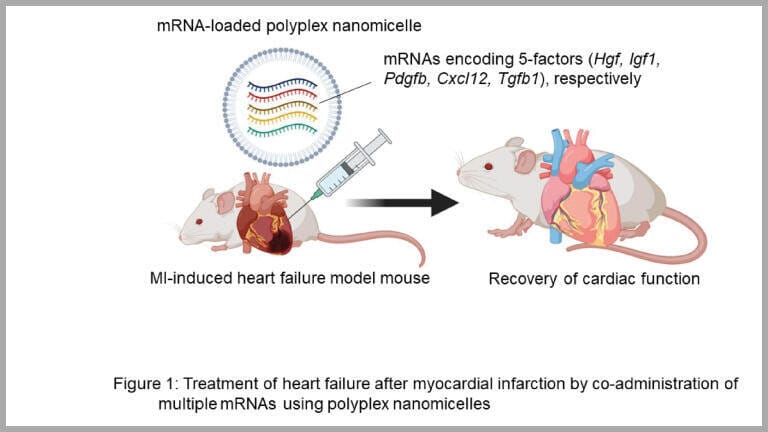
Researchers in Japan have now reported that a multipronged messenger RNA (mRNA) approach could help to reduce the risk of serious long-term cardiac damage. The team, based at The University of Osaka, has shown that simultaneous administration of five therapeutic messenger RNAs (mRNA) reduced heart tissue damage and improved heart function in a mouse model of myocardial infarction.
mRNA carries genetic instructions that cells use to make proteins. In this study, the researchers used the technology not to stimulate immunity – as in some vaccines – but to direct damaged heart tissue to produce proteins associated with repair and regeneration. The approach was designed to act on several damaging pathways at the same time, rather than to focus on a single target.
After a myocardial infarction, cardiac failure can develop because the heart has sustained several forms of injury. Inflammation can worsen tissue damage, scar tissue can replace functional cardiac muscle and individual heart cells can die. Reduced blood flow to the affected tissue can further limit recovery, while structural changes to the heart wall can impair its ability to contract effectively and pump blood around the body.
“The fact that a heart attack causes such complex damage to the heart makes it difficult to treat,” said lead author Dr. Kazuma Handa.
“Conventional treatments that only target one of these types of damage are typically not effective,” he said.
In the study, the researchers adopted a multifactorial strategy to treat the consequences of heart attack. They used polymer-based mRNA carriers – known as polyplex nanomicelles – to deliver five separate mRNAs directly to the hearts of mice with heart failure. Each mRNA encoded a protein considered important for tissue recovery, with the overall aim to promote repair, support blood vessel formation and limit further deterioration of the heart muscle.
“The results were very positive,” said senior author Dr. Keiji Itaka.
“Delivering the five-mRNA cargo to the damaged heart tissue promoted the formation of new blood vessels, inhibited scar tissue formation, increased tissue repair, and decreased the rate of heart cell death,” he added.
The researchers reported that these biological effects translated into measurable improvements in the overall condition of the animals. Mice treated with the five mRNAs showed improved heart contraction, thicker heart walls and better movement of blood through the heart. These improvements contributed to increased survival, suggesting that the treatment did more than alter molecular markers of injury but also improved cardiac performance in the disease model.
“Our findings suggest that this specific combination of five factors effectively promotes the repair of heart tissue damaged during a heart attack,” said Handa.
“Taking action early, in addition to promoting repair, also ensures that heart function is not significantly impeded long-term,” he concluded.
The study has demonstrated that a combination mRNA therapy can address several key features of heart damage after myocardial infarction in mice. By targeting inflammation, scar formation, cell death, tissue repair and blood vessel development, the approach reflects the complex biology of post-heart-attack heart failure more closely than single-target treatments.
The findings remain preclinical, and further work will be needed to assess safety, dosing, delivery, durability and effectiveness before any potential translation to human patients. Nevertheless, the study could provide a foundation for future treatments for heart failure after heart attack and may support the broader development of mRNA-based regenerative medicine.
For further reading please visit: 10.1002/smsc.20250052
ILM 51.6 Sept 2026



 Product directory




















,-photo-Karin-Allander.jpg)







.jpg)
