Research news
Stanford researchers have developed Microbe-Independent Deep Assembly and Screening – MIDAS – a polymerase chain reaction-based approach that allowed hundreds of protein variants to be assembled and tested in mammalian cells within 24 hours
Researchers at Stanford University, California, USA, have developed a faster and less costly method to build and test engineered proteins, with potential implications for drug discovery, synthetic biology, enzyme development and molecular design guided by artificial intelligence (AI).
The approach – called Microbe-Independent Deep Assembly and Screening (MIDAS) – was developed by Dr. Michael Z. Lin, professor of neurobiology and bioengineering in the schools of engineering and medicine, with graduate students Dr. Yan Wu, from bioengineering, and Pengli Wang, from chemical engineering. The method has reduced a protein construction and testing workflow that can take many days to a process that can be completed in about 24 hours.
Proteins are central to biology with increasingly significant industrial applications. They act as enzymes, structural components, signalling molecules and molecular machines, and engineered proteins already underpin major areas of modern biotechnology. Researchers are seeking to design proteins that could treat serious diseases, correct cellular dysfunction, support cancer research, improve environmental monitoring or act as improved enzymes in food production and consumer products such as detergents. AI can help to predict promising protein designs, but every proposed variant must still be produced and tested in living systems before its function can be confirmed.
That experimental validation has remained a major constraint. Conventional protein engineering usually requires researchers to construct the DNA instructions for each protein, clone those instructions in bacteria or yeast, grow individual microbial clones, retrieve the resulting genetic material and then transfer it into mammalian cells for functional analysis. The workflow is labour-intensive, slow and expensive, particularly when researchers need to compare large numbers of protein variants.
“The fundamental questions of molecular biology remain: how do we make better proteins and how do we understand what makes a protein work?” Lin said. “Doing that work takes valuable time and resources, but we’ve found a way to dramatically reduce those demands.”
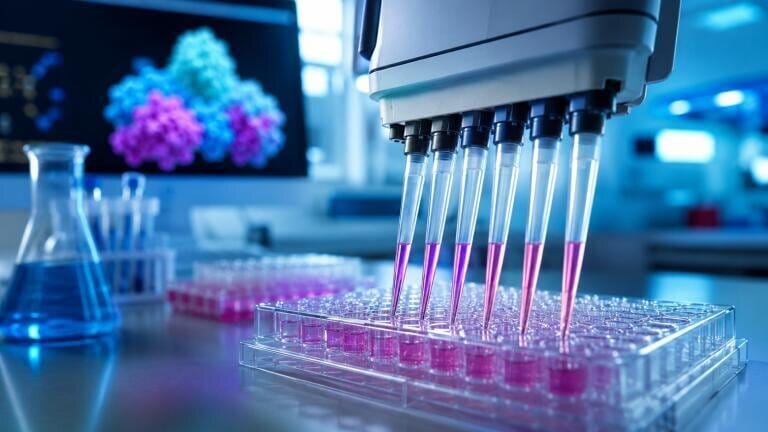
The MIDAS method avoided the traditional microbial assembly route by using polymerase chain reaction (PCR) to amplify and assemble linear segments of DNA. PCR can rapidly generate millions or billions of copies of genetic sequences. In the MIDAS workflow, the researchers used PCR to build full genes that mammalian cells could use to express specific protein variants. Those PCR-produced gene variants could then be transferred directly into mammalian cells for functional analysis, without first to clone them in microbes.
The only starting materials required for the PCR procedure were short DNA sequences known as primers, which can be ordered for next-day delivery. This made it possible to move rapidly from design to experimental testing.
“With MIDAS, we can receive PCR primers in the morning, assemble the necessary genes by mid-day, and by late afternoon transfer the genes into cells to observe how the proteins function,” co-first author Yan Wu said.
“And we can do this all for hundreds or thousands of protein variants in parallel at a time,” he added.
In standard protein engineering, once researchers identify a promising protein variant, they commonly assemble and clone the gene that encodes it into a circular genetic structure known as a plasmid. The modified plasmid must then be transferred into bacteria or yeast to produce enough plasmid DNA. That material must subsequently be recovered and transferred into mammalian cells if the protein needs to be assessed in a more biologically relevant system.
The Stanford team’s key insight was to eliminate the plasmid stage which does not fit naturally with PCR-based amplification. Instead, the researchers treated DNA as linear genetic information that could be assembled directly by PCR. This allowed them to produce hundreds of gene variants at the same time and transfer those variants directly into mammalian cells in sufficient quantities for performance tests.
“We decided there’s nothing magical about the circular structure of plasmids. For PCR, you just need the genetic data. That was the moment of inspiration,” Lin said.
The reported efficiency gains were substantial. In a practical test, the team used MIDAS to assess 384 variants with about four hours of hands-on laboratory work and about $2,000 in reagents. By comparison, the researchers estimated that conventional methods would require an experienced researcher approximately 192 hours and about $20,000 in reagents to evaluate just 24 variants. On that basis, they calculated that MIDAS was almost 50 times faster and about one tenth of the cost of cloning-based approaches.
The method could have immediate value for biological research. The authors said it should help to accelerate enzyme and biosensor studies, because both fields depend on the ability to compare many related protein variants and identify those with the most useful properties. It could also improve automated laboratory workflows, as PCR primers are well suited to modern liquid-handling robots that can process many samples in parallel.
The most important longer-term effect may lie in data generation. AI systems for protein design depend on large, high-quality datasets that link genetic sequence to molecular performance. Such sequence-fitness datasets allow computational models to learn which changes improve or damage protein function. By making real-world testing faster, cheaper and more scalable, MIDAS could help researchers to generate larger datasets and improve the training of molecular design models.
“We used MIDAS not only to find the best-performing version of a protein but also to understand how well closely related variants work, which is information we can use to train AI models,” co-first author Pengli Wang said.
“MIDAS is so easy that we can use it to create large data sets very quickly,” he added.
Lin said the method could support deeper combinatorial searches, closer integration with robotics and the production of gene sequence-molecular fitness maps that could feed improved machine-learning models. In practical terms, this could help to close the gap between computational protein design and laboratory validation, a gap that remains one of the main bottlenecks in AI-assisted biology.
“MIDAS is at least an order-of-magnitude faster at real-world validation. It compresses the engineering design-build-test cycle for proteins to just a couple of days, and we think it could drive rapid advances in AI-inspired molecular biology,” Lin concluded.
* Pengli Wang passed away in May 2026 after this research was completed. He was a fourth-year PhD student in chemical engineering.
For further reading please visit: 10.1038/s44320-026-00210-z
ILM 51.6 Sept 2026



 Product directory



















,-photo-Karin-Allander.jpg)






.jpg)
