Research news
Researchers have demonstrated that light-sensitive proteins can function as quantum sensors and respond to radio waves, opening a potential route to biological imaging technologies and remote control of cellular processes
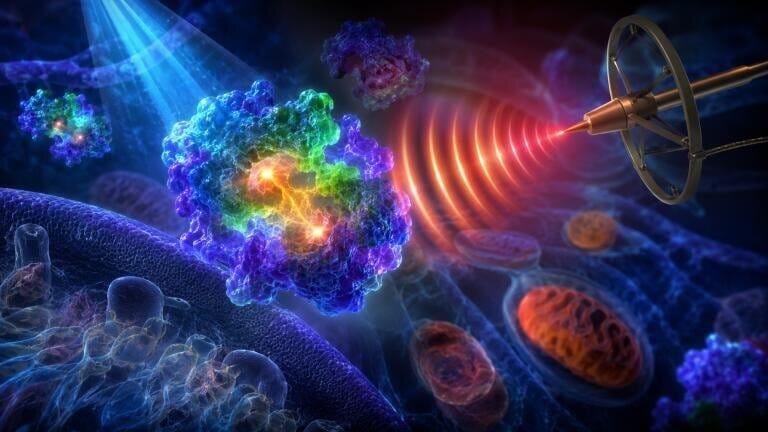
Scientists from the Technical University of Munich School, Germany, have demonstrated that naturally occurring proteins can act as quantum sensors and respond to radio waves, a breakthrough that could eventually allow researchers to embed quantum sensing technology directly within living cells and tissues.
The research marked a significant step towards the development of biological quantum devices. Until now, quantum sensing has largely relied on solid-state materials, particularly diamonds engineered to contain atomic-scale defects that enable highly sensitive measurements of magnetic and electromagnetic fields. While these systems have delivered remarkable performance, their size and physical properties have limited their use in biological environments.
The latest work transferred key principles of quantum sensing from engineered materials to proteins, which are biological molecules that cells can produce naturally through genetic processes. Because proteins can be modified with great precision and incorporated into living systems, they offer a potentially powerful alternative to conventional quantum sensing platforms.
“‘In contrast to established solid-state-based systems, protein-based approaches can not only serve as sensors but also open up the prospective possibility of controlling biological processes with radio waves in a targeted manner – an extremely exciting prospect,’” said Dr. Dominik Bucher, professor of quantum sensing at the Technical University of Munich (TUM) School of Natural Sciences and senior author of the study.
The researchers believe protein-based quantum sensors could prove particularly valuable for biosensing applications, including the imaging and monitoring of living cells, tissues and organs. Unlike conventional solid-state devices, which often require specialised hardware and can be difficult to integrate into biological systems, protein sensors could theoretically operate directly at the location where measurements are required.
Such an approach could enable scientists to investigate biological processes within living organisms with a level of proximity and precision that has been difficult to achieve using existing technologies.
The team focused on a class of light-sensitive proteins known as flavoproteins. These proteins play important roles in a range of biological processes and have attracted scientific interest because of their unusual quantum properties.
One of the proteins examined was cryptochrome, a molecule that biologists have studied extensively because of evidence that it may contribute to magnetic field detection in migratory birds. Protein samples used in the research were supplied by the laboratory of Professor Erik Schleicher at the University of Freiburg.
To initiate the quantum effects, the scientists exposed the proteins to blue light. This illumination generated so-called spin-correlated radical pairs, which are coupled electron pairs with highly unusual quantum characteristics. These radical pairs are exceptionally sensitive to magnetic fields and external electromagnetic influences.
When the radical pairs formed within the proteins, they altered the luminescence of the proteins. By measuring changes in light emission, the researchers could observe and monitor the quantum behaviour occurring within the biological molecules.
The team subsequently applied radio-frequency electromagnetic fields and found that they could deliberately modify the luminescence emitted by the proteins. The changes demonstrated that the underlying quantum states of the radical pairs could be manipulated even within a complex biological environment.
This finding provides direct evidence that electromagnetic fields can influence sensitive quantum states in proteins and offers a potential mechanism through which biological quantum devices might operate.
The proteins also functioned as magnetic field sensors capable of revealing magnetic field distributions within samples. Importantly, the information could be read entirely through optical methods, using light as the output signal. This approach resembles established solid-state quantum sensing technologies but relies on biological molecules rather than engineered crystalline materials.
Although the work remains at an early stage, the researchers believe it could have important implications for biotechnology, synthetic biology and biomedical research.
The ability to influence biological activity remotely through radio-frequency signals has long attracted interest because radio waves can penetrate biological tissues non-invasively. If researchers can harness this capability through engineered proteins, it could create entirely novel methods to regulate cellular behaviour without direct physical intervention.
Potential applications could include the activation of specific cellular pathways, control of gene activity, or the development of biological systems that respond to external electromagnetic commands.
“‘The possibilities range from biological quantum sensors to radio wave-controlled cell activity, such as remotely controlled gene expression,’” said Kun Meng, a doctoral candidate at TUM and first author of the study.
The findings have provided an early proof of principle that quantum phenomena can be harnessed within genetically accessible biological molecules. While substantial technical challenges remain before practical applications become possible, the work has established a foundation for a field that combines quantum technology, molecular biology and biotechnology.
As researchers continue to refine these approaches, protein-based quantum systems could eventually offer a route to sense, image and control biological processes from within living organisms themselves, extending quantum technologies beyond the laboratory and into the realm of cellular function.
For further reading please visit: 10.1038/s41587-026-03158-5
ILM 51.6 Sept 2026



 Product directory



















,-photo-Karin-Allander.jpg)





.jpg)
