Research news
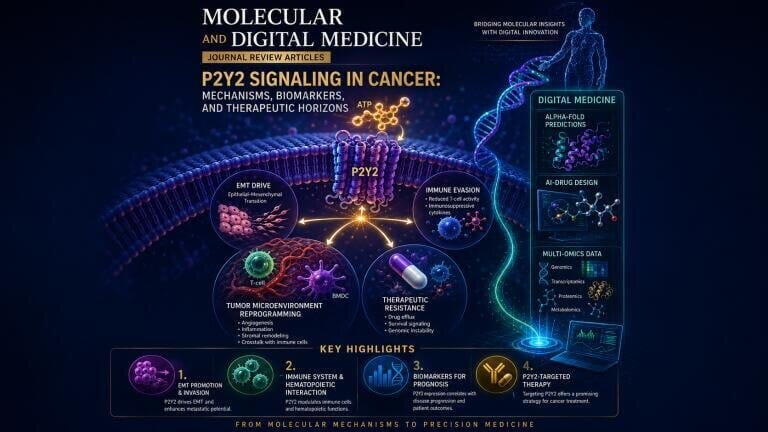
A review of evidence has indicated that the P2Y2 receptor – a purinergic signalling receptor activated by extracellular adenosine triphosphate and uridine triphosphate – may influence cancer cell proliferation, migration, tumour microenvironment biology
A research team in Singapore has reviewed the emerging evidence that the P2Y2 receptor may have an important but highly context-dependent role in cancer biology, with possible implications for tumour progression, biomarker discovery and future therapeutic strategies.
Purinergic signalling refers to cellular communication mediated by purines and related extracellular nucleotides, including adenosine triphosphate and uridine triphosphate. These molecules are widely known for their intracellular roles in energy transfer and metabolism but outside the cell they can also act as signalling molecules. By binding to purinergic receptors on the surface of cells, they can influence inflammation, immune activity, vascular responses and tissue repair.
The review examined the P2Y2 receptor which is a G protein-coupled receptor activated by extracellular adenosine triphosphate and uridine triphosphate. G protein-coupled receptors are a large family of cell-surface receptors that translate extracellular signals into intracellular responses. Because many licensed medicines already act through this receptor class, the biology of individual G protein-coupled receptors remains of considerable interest in drug discovery.
The authors reported that P2Y2 receptor signalling has been associated with several cancer-related processes in previously published studies. These included tumour cell proliferation, migration and epithelial–mesenchymal transition, a biological programme through which epithelial cells acquire more mobile and invasive features. Epithelial–mesenchymal transition has been widely studied in relation to cancer invasion, metastasis and resistance to treatment with its effects varying according to tumour type and disease setting.
The review also discussed links between P2Y2 receptor activity and intracellular signalling pathways that are central to cancer biology. These included epidermal growth factor receptor signalling, phosphoinositide 3-kinase–protein kinase B signalling and mitogen-activated protein kinase signalling. The full forms of epidermal growth factor receptor, phosphoinositide 3-kinase and mitogen-activated protein kinase are known. Protein kinase B is referred to as AKT. These pathways can regulate cell growth, survival, motility and responses to external stress, which makes them important in the study of tumour development and treatment resistance.
The authors said the P2Y2 receptor may also have relevance within the tumour microenvironment. The tumour microenvironment comprises not only malignant cells but also stromal cells, blood vessels, immune cells, extracellular matrix and soluble signalling molecules. Extracellular adenosine triphosphate can be released by tumour cells and surrounding stromal cells, particularly under conditions of cellular stress, injury or inflammation. Once present outside the cell, it may activate purinergic receptors and alter inflammatory responses, angiogenesis, immune signalling and interactions between malignant and non-malignant cells.
The review stressed that these effects were not uniform. P2Y2 receptor signalling may produce different outcomes depending on tumour type, receptor expression, nucleotide availability, cellular context and the wider signalling environment. This point is important because cancer biology rarely follows a single linear pathway. A receptor that promotes invasive behaviour in one tumour model may have a different or more limited effect in another.
The authors also considered whether P2Y2 receptor expression could act as a measurable biological feature to indicate disease presence, prognosis, treatment response or disease progression. According to the review, bioinformatic and experimental studies have reported associations between P2Y2 receptor expression and disease progression or prognosis in some cancers. However, the authors cautioned that these observations require further validation before they can be translated into clinical use.
The review also examined potential approaches to target the P2Y2 receptor. These included pharmacological modulation, in which small molecules or other agents alter receptor activity and gene-based strategies designed to influence receptor expression or signalling. Although compounds that target purinergic receptors have been developed for other clinical contexts, the use of P2Y2 receptor-directed approaches in oncology remains investigational.
The authors concluded that P2Y2 receptor biology has become an important area for further research but they indicated that stronger mechanistic and translational evidence will be needed. Future studies will need to clarify when P2Y2 receptor signalling promotes tumour growth or invasion, when it affects immune or stromal responses and whether it can be exploited safely as a biomarker or therapeutic target.
Overall, the review has consolidated current knowledge on the P2Y2 receptor in cancer and has identified several areas where the evidence remains incomplete. Its central message is that purinergic signalling should not be regarded as a simple, uniform driver of cancer progression. Instead, the P2Y2 receptor appears to operate within a complex and tumour-specific signalling landscape that will require careful study before clinical applications can be defined.
For further reading please visit: 10.1016/j.mdmed.2026.100001
ILM 51.6 Sept 2026



 Product directory




















,-photo-Karin-Allander.jpg)







.jpg)
