
Research news
Novel SEE-CITE platform enables precise, quantitative comparison of how small molecules bind to protein targets, offering improved insight into drug specificity and off-target effects
A research collaboration led by University of California, Los Angeles, USA, has unveiled a novel analytical technology that may allow scientists to define with greater precision how small molecules – including many therapeutic agents – bind to proteins. The tool is called SEE-CITE and builds on the established laboratory technique of photo-crosslinking but introduces a mechanism that produces a consistent and interpretable chemical signature at the site of interaction.
Small-molecule drugs exert their biological effects primarily through selective binding to protein targets, often enzymes or receptors that regulate cellular processes. Accurate identification of the binding site is therefore central to rational drug design. Conventional photo-crosslinking – first introduced in 1969 – has enabled researchers to capture such interactions by attaching a light-sensitive chemical tag to a molecule. Upon exposure to ultraviolet light, this tag forms a covalent bond with the protein at the point of contact. The chemical remnants left after crosslinking, however, have historically varied in structure which has hindered direct comparison between different molecules so reducing analytical reliability.
The SEE-CITE platform addresses this limitation through a molecular design that allows the probe to detach from its payload after crosslinking, leaving behind a uniform ‘chemical calling card’. This standardisation has enabled quantitative comparison of how distinct molecules compete for the same binding site within a single experiment, a capability that has remained difficult to achieve with earlier approaches. The research team has also refined a widely used computational analysis tool to improve interpretation of the complex datasets generated by the method which has further strengthened analytical consistency.
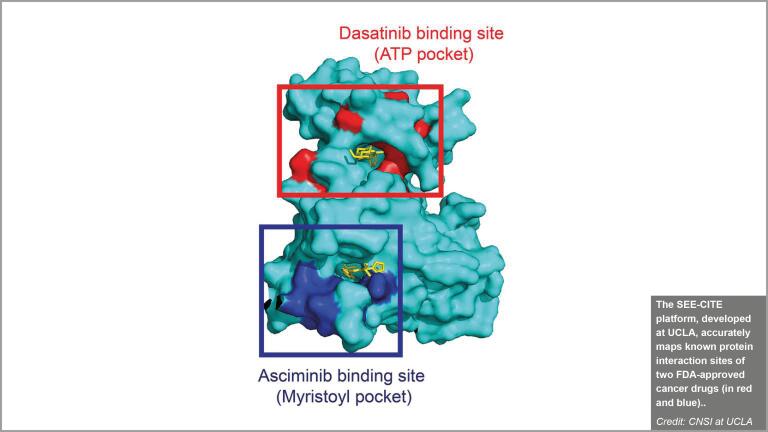
To validate the approach, the investigators examined two clinically relevant anticancer agents – dasatinib and ascinimib – which target different sites on the same protein kinase implicated in leukaemia. Kinases are enzymes that regulate signalling pathways through phosphorylation and mutations in these proteins can drive malignant transformation. The SEE-CITE analysis reproduced established binding interactions for both drugs – confirming the method’s accuracy – and also revealed previously uncharacterised interactions. Ascinimib, a more recent therapeutic agent with a comparatively favourable safety profile, notably exhibited fewer off-target kinase interactions, which has provided mechanistic insight into its reduced side-effect burden.
The ability to resolve such distinctions has significant implications for drug discovery and development. One persistent challenge in early-stage research is to determine whether a candidate molecule engages the intended functional site on a target protein while avoiding unintended interactions elsewhere in the proteome. Off-target binding can lead to toxicity or diminished efficacy and methods that allow systematic evaluation of these effects are therefore of high value.
By enabling direct, quantitative comparison of binding events across multiple compounds, SEE-CITE has the potential to support more informed selection of drug candidates and to accelerate optimisation cycles. The technology may also assist researchers to uncover previously unrecognised biological activities of existing molecules which could open up new therapeutic indications.
Beyond oncology, the approach may find application in fields such as cholesterol regulation, metabolic liver disease and other conditions in which protein–ligand interactions underpin disease mechanisms.
In practical terms, the method offers a more reliable framework for mapping molecular engagement at the protein level and for assessing specificity across complex biological systems. As such, it represents a substantive refinement of photo-crosslinking methodologies and a step towards more predictive and mechanistically grounded drug discovery.
For further reading please visit: 10.1038/s41557-026-02127-4
ILM 51.6 Sept 2026



 Product directory


















,-photo-Karin-Allander.jpg)






.jpg)
