Research news
Discovery of stable single-electron covalent bond in carbon compound validates a century-old theory
Covalent bonds, in which two atoms are bound together by sharing a pair of electrons, form the scaffolding that underpins the majority of organic compounds. In 1931, the Nobel Laureate Linus Pauling suggested that covalent bonds made from just a single, unpaired electron could exist but these single-electron bonds would likely be much weaker than a standard covalent bond involving a pair of electrons.
Since then, single-electron bonds have been observed, but never in carbon or hydrogen – the hunt for one-electron bonds shared between carbon atoms had so far eluded scientists.
Now, a team of researchers from Hokkaido University has isolated a compound in which a single electron is shared between two carbon atoms in a remarkably stable covalent bond, known as a sigma bond.
“[Explaining] the nature of single-electron sigma-bonds between two carbon atoms is essential to gain a deeper understanding of chemical-bonding theories and would provide insights into chemical reactions,” explained Professor Yusuke Ishigaki, Department of Chemistry, Hokkaido University, a co-author of the study.
The single-electron bond was formed by subjecting a derivative of hexaphenylethane, which contained an extremely stretched out paired-electron covalent bond between two carbon atoms, to an oxidation reaction in the presence of iodine. The reaction produced dark violet-coloured crystals of an iodine salt.
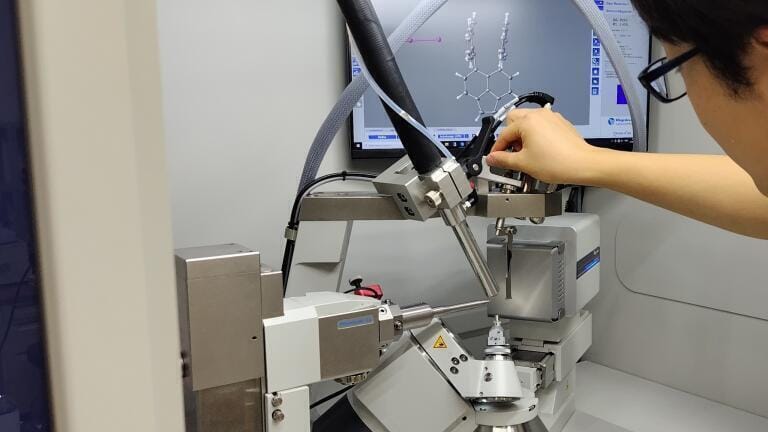
The team used X-ray diffraction analysis to study the crystals and found that the carbon atoms in them were extremely close together, suggesting the presence of single-electron covalent bonds between carbon atoms. They were then able to confirm this using Raman spectroscopy.
“These results thus constitute the first piece of experimental evidence for a carbon-carbon single-electron covalent bond, which can be expected to pave the way for further developments [in this branch] of chemistry for this scarcely explored type of bonding,” said Takuya Shimajiri, the lead author of the paper and now at the University of Tokyo.
For further reading please visit: https://pubmed.ncbi.nlm.nih.gov/39322667/
ILM 51.6 Sept 2026



 Product directory


















,-photo-Karin-Allander.jpg)




.jpg)
