Research news
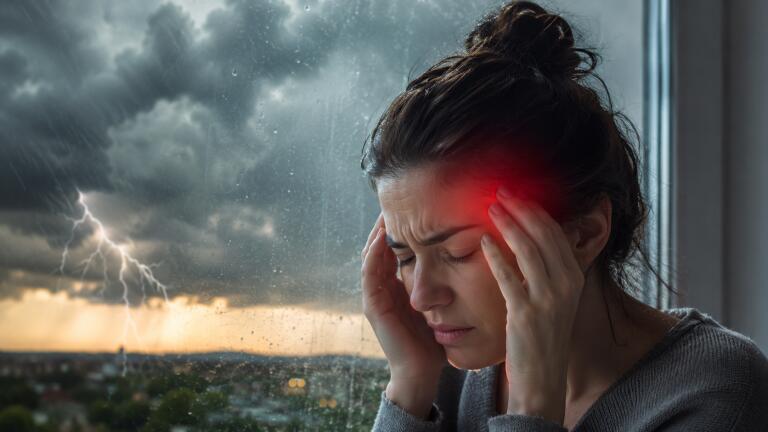
Researchers have identified weather systems associated with increased headache onset in people with episodic migraine and reported that preventive treatment with fremanezumab reduced weather-associated attacks
Researchers have identified two weather patterns that may increase the risk of headache onset in people with episodic migraine, in work led by physicians at the University of Cincinnati College of Medicine, Ohio, USA, alongside collaborators from the Icahn School of Medicine at Mount Sinai in New York, Errex Inc. and Teva Pharmaceuticals who sponsored the study.
Headaches and migraine attacks have long been associated with weather variables, including barometric pressure, precipitation, humidity and temperature. However, the effect of weather has appeared to differ across geographic regions, seasons and population groups which has made it difficult to isolate the conditions most closely associated with attacks.
“Weather is one of the most common triggers for attacks of migraine headache,” said Dr. Vincent Martin, study author and professor of clinical medicine in the department of internal medicine and also director of the Headache and Facial Pain Center at the University of Cincinnati Gardner Neuroscience Institute.
“Our investigation suggests that specific storm patterns may help explain why weather-related headaches and migraines are so frequent in Cincinnati and the Midwest region [of the USA],” he said.
The study analysed weather patterns in the northeast USA to assess whether particular combinations of meteorological conditions were associated with headache onset among patients with episodic migraine. The researchers said the approach differed from many earlier studies because it examined weather systems as clusters of variables rather than to focus on a single factor, such as temperature or atmospheric pressure.
“What is significant about this headache research is that we are one of the first to look at weather patterns with a combination of variables, instead of a single weather variable,” said Martin.
“We further examined those weather patterns by region and season,” he added.
The team found that two weather patterns were associated with a higher risk of headache onset in the region studied. The first was an approaching cold front – or low-pressure system – accompanied by precipitation, a pattern that can occur in all seasons. The second was the ‘Bermuda High’, a high-pressure system that strongly influences summer weather across the eastern half of the USA.
“This is one of the first studies to more closely implicate frontal passage in the onset of headache,” said Al Peterlin, co-investigator and meteorologist at Errex Inc, which is a biometeorology company.
To reach its findings, the research team compared thousands of daily headache diary entries from participants across northeastern USA sites involved in the HALO-EM and HALO-LTS studies. Both were randomised, double-blind, placebo-controlled Phase III clinical trials that assessed the safety and efficacy of fremanezumab – marketed as Ajovy – and used for prevention of episodic migraine.
The investigators linked headache diary data with daily meteorological records from the US National Climatic Data Center and tracked four years of weather patterns in three-day windows. This design allowed the team to examine whether specific weather systems preceded or coincided with onset of headache.
The researchers have also reported that at least six months of treatment with fremanezumab significantly reduced the rate of headache onset compared with no medication across all weather patterns, including conditions classed as high risk for headache onset.
“We saw the weather and headache relationship wiped out with the use of this medication,” said Dr. Fred Cohen, co-investigator and faculty member at the Icahn School of Medicine at Mount Sinai.
“We started to notice its effectiveness as early as one month after the start of the medication,” he added.
For further reading please search for:
Weathering the Storm: Fremanezumab Reduces Weather-Associated Headaches in the Northeast United States
ILM 51.6 Sept 2026



 Product directory




















,-photo-Karin-Allander.jpg)






.jpg)
