Research news
Researchers in Brazil have reported that high-frequency ultrasound can rupture viral envelopes in pathogens such as severe acute respiratory syndrome coronavirus 2 and H1N1 influenza, opening a possible route to waste-free antiviral treatment that does not promote resistance
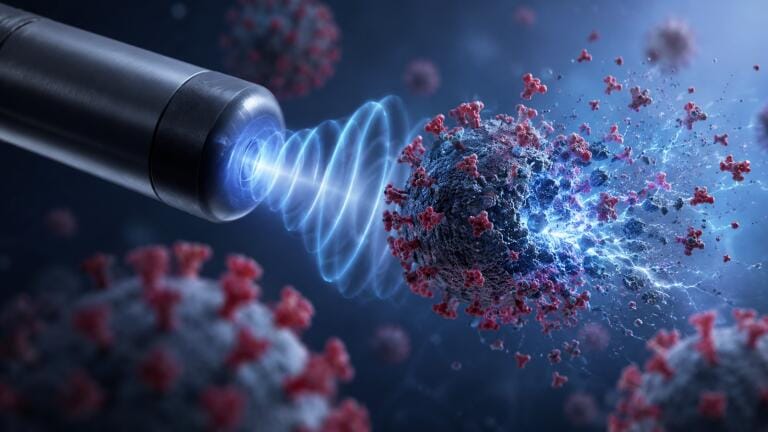
A team at the University of São Paulo in Brazil has shown that high-frequency ultrasound waves – similar to those used in medical examinations – can inactivate viruses such as severe acute respiratory syndrome coronavirus 2, the virus that causes COVID-19, and the emerging influenza virus H1N1, all without damaging human cells.
The study has described how acoustic resonance can cause structural disruption in enveloped viral particles until they rupture and lose their ability to infect host cells. The researchers said the finding pointed to a potential therapeutic route for viral diseases, although the approach is experimental and not yet close to clinical use.
Acoustic resonance occurs when an external sound wave transfers energy efficiently into a structure at a frequency that matches its physical properties. Here the researchers reported that spherical enveloped viruses could absorb ultrasound energy in a way that destabilised their outer membrane, its ‘envelope’. Once the envelope deformed and ruptured, the virus could no longer invade human cells.
“It’s kind of like fighting the virus with a shout. In this study, we proved that the energy of sound waves causes morphological changes in viral particles until they explode, a phenomenon comparable to what happens with popcorn.
“By degrading the structure of the pathogen, the protective membrane of the virus bursts and deforms, preventing the virus from invading human cells,” said Dr. Odemir Martinez Bruno, professor at the São Carlos Institute of Physics at the University of São Paulo, who coordinated the study.
The finding could be significant because enveloped viruses include a wide range of medically important pathogens. The team has already begun in vitro tests against other infections, including dengue, chikungunya and Zika. The researchers said the technique could be especially valuable because antiviral drugs are often difficult to design, optimise and deploy at scale, particularly when viral mutation can reduce treatment effectiveness.
“Although it’s still far from clinical use, this is a promising strategy against enveloped viruses in general, since developing chemical antivirals is complex and yields difficult results. Furthermore, it’s a ‘green’ solution, as it generates no waste, causes no environmental impact, and doesn’t promote viral resistance,” said Dr. Flávio Protásio Veras, professor at the Federal University of Alfenas, Alfenas, Brazil and a São Paulo Research Foundation postdoctoral fellow.
The research brought together specialists from several disciplines, including theoretical physics, acoustics, virology, inflammatory disease, pharmaceutical science, microscopy and toxicology. It included researchers from the São Carlos Institute of Physics, the Virology Research Centre and the Centre for Research in Inflammatory Diseases, both affiliated with the Ribeirão Preto Medical School, the School of Pharmaceutical Sciences and the Faculty of Science and Technology at São Paulo State University. These groups contributed structural and toxicological analyses, including microscopy and light scattering.
The team also received support from Dr. Charles Rice, professor at Rockefeller University in the USA, and the winner of the 2020 Nobel Prize in Physiology or Medicine. Rice provided fluorescent viruses that allowed the researchers to visualise the process in real time.
The researchers said the results were unexpected because they appear to challenge assumptions derived from classical physics. Ultrasound wavelengths are much longer than viral particles, which would usually suggest that a direct mechanical interaction should be unlikely. Yet the experiments indicated that geometry was critical. Many enveloped viruses are approximately spherical, and the team found that this shape allowed the particles to absorb ultrasound energy effectively.
“The phenomenon is entirely geometric. Spherical particles, such as many enveloped viruses, absorb ultrasound wave energy more effectively. It’s that accumulation of energy inside the particle that causes changes in the structure of the viral envelope until it ruptures. Therefore, if viruses were triangular or square, they wouldn’t undergo the same ‘popcorn effect’ of acoustic resonance,” Bruno said.
He added that the dependence on viral shape rather than genetic sequence could make the approach less vulnerable to the emergence of variants. Mutations such as those seen in COVID-19 variants including Omicron and Delta would not be expected to change the physical principle that underpins the technique, provided the particle retained the relevant geometry and envelope structure.
The researchers also distinguished acoustic resonance from ultrasound decontamination methods already used in clinical and laboratory settings. Ultrasound can be used to sterilise dental and surgical equipment.
“The technique isn’t intended for decontamination. That already exists. Ultrasound is already used to sterilize dental and surgical equipment, but it works through a different physical phenomenon called cavitation [low-frequency ultrasound causes gas bubbles to collapse] which destroys biological material,” Bruno said.
He explained that acoustic resonance uses higher frequencies, between 3 and 20 megahertz, and acts through a different mechanism. Rather than to generate destructive bubbles, the ultrasound energy couples with the viral structure and excites internal vibrations. These vibrations can rupture the viral envelope without change to the temperature or acidity of the surrounding medium.
The researchers said this selectivity was central to the potential safety of the approach. In their experiments, only the virus absorbed the energy in a way that destabilised its structure, while human cells were not damaged. Further work will be needed to test whether the same effect can be reproduced across a wider range of viruses, biological conditions and eventually animal models.
The São Paulo Research Foundation supported the study. The public institution funds scientific research across all fields of knowledge through scholarships, fellowships and grants for investigators linked with higher education and research institutions in the state of São Paulo in Brazil.
For further reading please visit: 10.1038/s41598-026-37584-x
ILM 51.6 Sept 2026



 Product directory




















,-photo-Karin-Allander.jpg)








.jpg)
