Research news
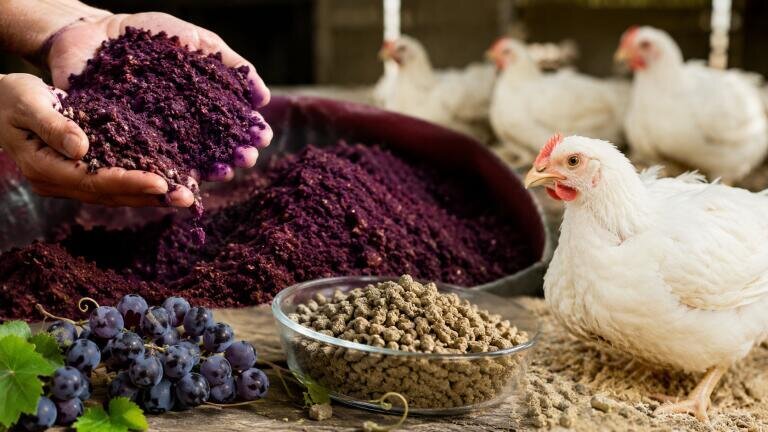
Cornell University researchers have reported that grape pomace, the pulpy residue left after wine production, could help to improve chicken growth, feed efficiency and gut health without the routine use of antibiotic growth promoters which have been associated with the spread of antimicrobial resistance
Every year, wine production leaves behind millions of litres of grape pomace, the pulpy mixture of skins, seeds, stems and peels that remains after grapes have been pressed. Wineries often face practical and environmental challenges to dispose of this residue but a research team at Cornell University, Ithaca, New York, USA, has reported that the material could have a valuable second use as a feed additive for chickens raised for meat production.
A team of food scientists has tested grape pomace as a dietary additive in poultry production and compared its performance directly with zinc bacitracin, one of the most widely used antibiotic growth promoters in the poultry industry.
The researchers found that a modest inclusion rate of 0.5 per cent grape pomace per unit made of feed almost matched the performance of the antibiotic treatment. Birds that received the additive showed improved weight gain, better feed efficiency and signs of healthier intestinal function, even when raised on a diet designed to induce gut inflammation.
“We’ve been studying this as a functional food ingredient for both humans and animals, and this is a defining moment,” said Dr. Elad Tako, corresponding author and associate professor of food science at Cornell University.
“We were able to mitigate low-grade inflammation which is status quo in the poultry industry.”
The search for alternatives to antibiotic growth promoters has become a major issue for poultry producers. These drugs have historically helped birds to grow faster and use feed more efficiently, partly by suppressing harmful bacteria and reducing chronic, low-grade inflammation in the gut. However, concern that routine agricultural antibiotic use can contribute to antimicrobial resistance has led many regulators and producers to restrict or eliminate their use.
“There is a full ban of the use of antibiotic growth promoters in the EU, China and Brazil,” said Tako.
“There’s not yet a formal ban in the USA but there’s a significant need because of the threat of … antibiotic resistance.”
To recreate the type of intestinal stress often seen in commercial poultry production, the research team fed 126 young broiler chickens* a diet containing 30 per cent rice bran. This high-fibre ingredient is known to provoke chronic low-grade inflammation in the gut. Birds that received the inflammatory diet without supplementation showed significantly reduced weight gain and higher levels of two proteins used as molecular markers of inflammation.
When the researchers added grape pomace at just 0.5 per cent of the diet, body weight gain increased by at least 79 per cent compared with inflamed birds that received no supplement. Feed conversion, a key measure of how efficiently birds convert feed into body mass, also improved to levels comparable with those seen in the zinc bacitracin group. These benefits remained evident during the final days of the 42-day experiment.
“Previous research by others showed negative effects of pomace in the feed because it was too much of a good thing,” said Tako.
“What we did was revisit the approach and reduce the dose,” he added.
The findings suggest that a low-dose grape pomace additive could help to support broiler productivity while reducing reliance on antibiotic growth promoters. The approach could also provide a circular economy benefit by redirecting a winemaking byproduct into animal feed rather than treating it solely as waste.
If the strategy proves effective at commercial scale, it could offer poultry producers a practical way to improve bird health and feed efficiency while addressing one of agriculture’s most persistent antimicrobial resistance challenges.
* A broiler chicken is an American English term for a chicken bred and raised specifically for meat production rather than for egg production
For further reading please visit: 10.1038/s41522-026-00996-8
ILM 51.6 Sept 2026



 Product directory



















,-photo-Karin-Allander.jpg)







.jpg)
