Mass spectrometry & spectroscopy
Published over 11 years ago. See the latest and most current information on Mass spectrometry & spectroscopy.
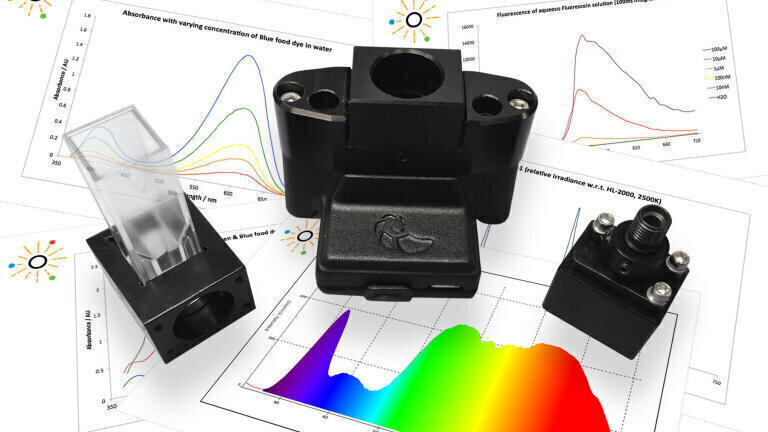
Ocean Optics' new Spark spectral sensor uses optical technology advances to shrink instrument size, making it the smallest on the market to date. The Spark-VIS is the first offering in the Spark line of versatile spectral sensors, delivering high-resolution measurements over the visible wavelength range of 380-700 nm.
Available in both OEM and stand-alone configurations, the compact low-cost Spark-VIS is suitable for simple absorbance, fluorescence and emissive colour measurements. It can be embedded to power next-generation portable and internet-connected sensing devices for environmental, food, agriculture, biomedical and quality control applications; integrated directly on processing lines; or used as a benchtop instrument in teaching, research, medical and quality control labs.
The Spark-VIS is the first Ocean Optics spectral device to replace traditional diffraction gratings with a solid-state optical encoder. The resulting unit size and cost are comparable to that of a less robust RGB filter diode detector, but with the ability to take full spectral measurements. Compatible with Ocean Optics’ Raspberry Pi development kit, the Spark-VIS can be purchased off the shelf for applications engineering. The same spectral sensor can then be bought economically in bulk for use as a component in portable and internet-enabled devices.
The stand-alone Spark-VIS is easy to use, with plug and play USB connectivity. Its low cost makes it a good option for budget-conscious student labs. The even smaller OEM version runs off the host device’s driver and communication electronics, connected by ribbon cable. A line of Spark accessories, including clip-on cuvette holders, diffusers, and light sources, is compatible with both versions.
Spark has remarkable performance for a spectral sensor of its kind. Its aperture design optimises light throughput. Robust optoelectronics ensure thermal stability over a -10° – 60° C operating range, for accurate analysis even in harsh environments. Unlike comparable devices, Spark delivers optical resolution of 4.5-9.0 nm (FWHM), making it viable for a wide range of applications.
ILM 51.6 Sept 2026





 Product directory