Microscopy & microtechniques
Published over 6 years ago. See the latest and most current information on Microscopy & microtechniques.
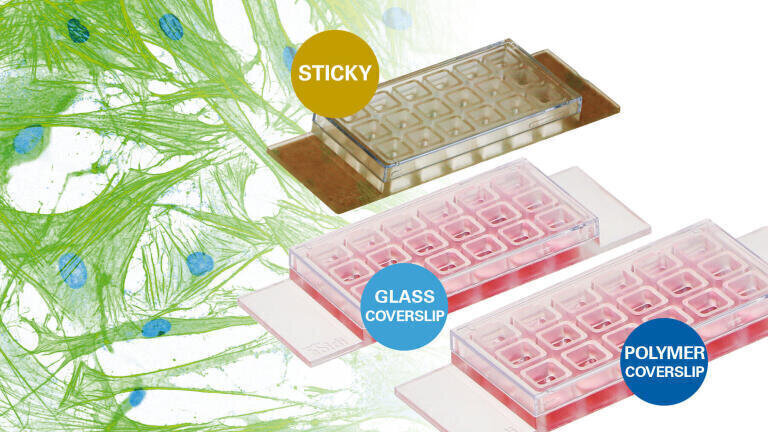
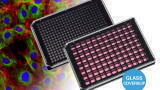
Perform high-resolution, cost-effective cell culture experiments with ibidi’s latest innovative labware technology, the µ-Slide 18 Well family.
With its thin ibidi Polymer Coverslip Bottom, the µ-Slide 18 Well allows for excellent cell adhesion onto the tissue culture-treated surface. In addition, it has the highest optical quality and is ideally suited for a variety of microscopic techniques, such as widefield fluorescence, confocal microscopy, and DIC.
For scientists who perform special microscopic applications, such as TIRF and super-resolution microscopy, ibidi provides the µ-Slide 18 Well Glass Bottom with a #1.5H D 263 M Schott glass. It is also available as a sticky-Slide 18 Well without any bottom, which enables the researcher to mount any chosen substrate.
The entire µ-Slide 18 Well family is ideal for experiments with small cell numbers and low reagent volumes. The spaces between the individual well walls minimise any well-to-well crosstalk and contamination. Scientists who would like to test one of the µ-Slide 18 Well variations with their own experiments can request free samples.
More information online
ILM 51.6 Sept 2026


 Product directory


.jpg)
.jpg)
















.jpg)
