Microscopy & microtechniques
Published over 13 years ago. See the latest and most current information on Microscopy & microtechniques.
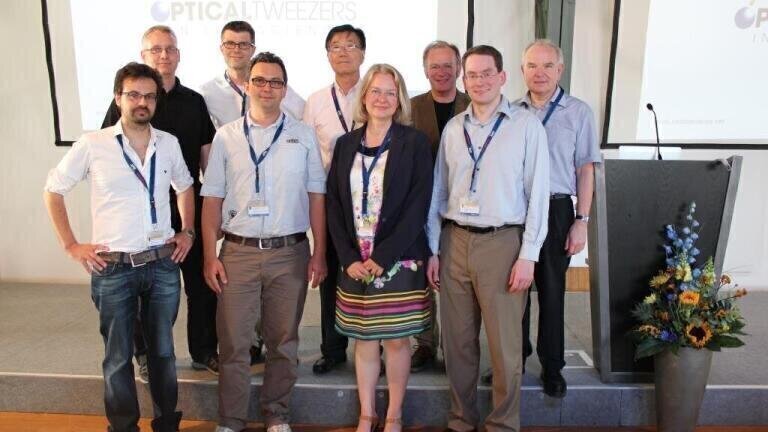
This year's symposium was held on the 18th June in Berlin at the excellent Palisa De/Umspannwerk Ost. A sweltering Berlin welcomed over sixty scientists from around the world to discuss their results and share scientific knowledge in a relaxed and informal atmosphere. NanoBioVIEWS™ is the name of a series of international meetings initiated by JPK Instruments to further the scientific knowledge exchange on instrumentation and applications of nanotechnology in the life sciences.
The invited speakers came from Europe, North America and Asia and gave diverse and interesting talks on how they view and/or apply optical tweezers in their research activities. Topics ranged from the theoretical to the practical. Homemade and commercial systems were shown to deliver top-level data while new techniques eyeing the future were also aired. Notable was the 4π AFM approach from the University of Bristol applying multiple holographically generated optical traps which could steer a nanorod ‘tip’ in a three dimensional scan with six degrees of freedom.
The annual poster competition produced some heated discussion between the judges, the invited speakers. Some eighteen research groups presented their work. The winning entry came from a multi-disciplinary team from the University of Modena e Reggio Emilia. Led by the Physics Department's Punam Sonar, the poster described a study of the HIV-1 protease folding pathways at the single molecule level using optical tweezers. The goal for the work is to help the design of effective folding inhibitor drugs for HIV-1PR.
JPK's CTO, Torsten Jähnke, commented on this year's meeting: "This was a particularly satisfying meeting with a consistently high level of oral and poster presentations. It is clear that optical tweezers are now being applied to provide solutions to challenges in the life sciences as the fundamental aspects are now accepted by the scientific community. The posters were very strong this year with professors standing alongside students to discuss their systems and applications. "
Visit the website to read the abstracts from the presentations and see pictures of the meeting.
ILM 51.6 Sept 2026



 Product directory


.jpg)