Microscopy & microtechniques
Published over 13 years ago. See the latest and most current information on Microscopy & microtechniques.
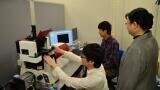
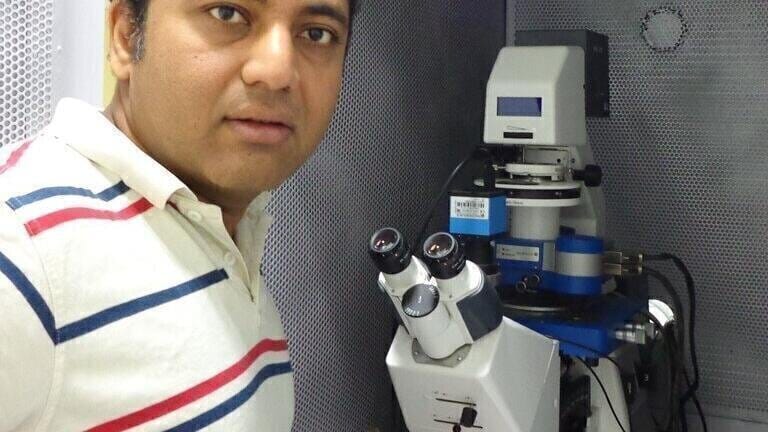
JPK Instruments reports on the work of the Nano-Mechanics Laboratory at the Indian Institute of Science Education & Research (IISER) Pune, India.
The Nano-mechanics group develops and uses novel techniques to understand molecular processes and has recently developed new instrumentation in the fields of single molecule force spectroscopy and correlation spectroscopy. There are three main areas of research: protein folding using AFM, measuring the mechanical properties of supported lipid bilayers and following the mechanical response of nano-confined fluids. This last area is performed on home-built instruments.
Assistant Professor, Shivprasad Patil, leads the research team. He describes his work and reasons for selecting JPK's NanoWizard® AFM platform and CellHesion™ modules to help speed his research efforts. "For our protein folding research, we modified our JPK system to enable the detection of the change in fluorescence intensity as the protein unfolds. We will measure the autocorrelation of such intensity fluctuations as the protein visits its complex energy landscape when clamped at different loads. We have modified the AFM to excite the tip-sample junction and collect the light from single molecule under a given load. In the future, we plan to perform autocorrelation of fluorescence intensities as the protein fluctuates across various conformations."
Making the choice to buy from JPK was quite simple: "One of the important things about JPK instrument is its ability to provide access to the optical tip-sample junction. This helped us in modifying it for our need to attach fluorescence correlation spectroscopy to it."
Describing the lipid bilayer mechanical property studies, Professor Patil continued: "Straining supported bi-layers and measuring the stress generated in lipid-bi-layer systems in important from the perspective of understanding the processes of endocytosis and exocytosis in intracellular transport. We are using JPK's CellHesion module to measure bending rigidity of lipid bi-layers. This allowed us to pull on tethers formed from supported bi-layers by 50 to 100 microns. Having this 100 micron pulling range is most important to our work and appears unique when compared to competitive systems."
ILM 51.6 Sept 2026


 Product directory


.jpg)