News
Published over 4 years ago. See the latest and most current information on News.
A collaboration between Tokai University, Toyohashi University of Technology, Chubu University and Denso Corporation have been developing testing equipment to detect SARS-CoV-2 with support from the Japan Agency for Medical Research and Development. The group has succeeded in developing a biosensor based on a new mechanism and detecting SARS-CoV-2. The development will now be accelerated toward practical application to contribute to early diagnosis of infectious diseases, which is a key factor in limiting virus' spread.
It is essential to prevent the spread of viruses by early diagnosis and isolation to prevent the medical system from being overwhelmed due to viral infectious diseases. At present, PCR tests and antigen tests are used for the diagnosis of SARS-CoV-2. However, these tests cannot evaluate ‘virus infectivity’, which indicates the power of the detected virus to infect. There has been growing demand for a high-sensitivity and simple detection method to evaluate viral infectiousness.
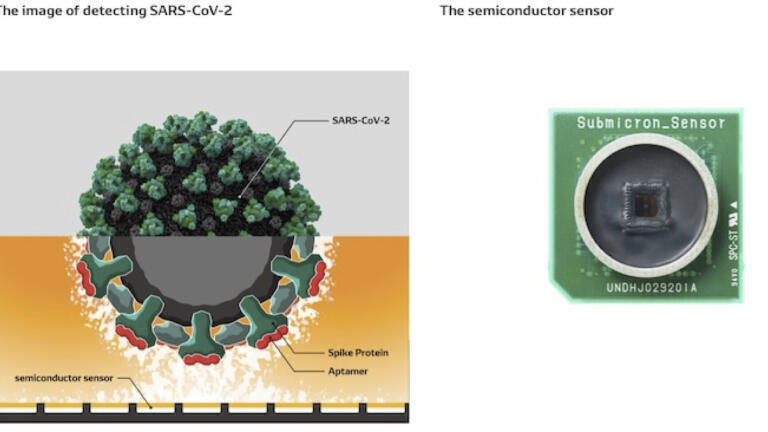
The universities and Denso have been developing a biosensor for clinical testing equipment to enable high sensitive and quick quantitative detection of viral infectivity. Unlike PCR tests and antigen tests, the biosensor detects the spike protein on the virus surface, which triggers infection, by using a semiconductor sensor and aptamer. The group has succeeded in developing highly sensitive detection of SARS-CoV-2 with high sensitivity by using this technique for the first time in the world.
The semiconductor sensor can quantitatively measure the viral load by using electrical signals. Thus, it is expected to be used to determine the status of infection and confirm the efficacy of treatment with high accuracy. An aptamer is small in size and binds selectively to various types of protein. It is also easy to design and can be mass-produced quickly, and so the aptamers can be used to detect unknown viruses.
The goal of the development of the biosensor by the universities and Denso is to determine the infectivity of SARS-CoV-2 and offer novel tests which have virus detection sensitivity equivalent to that of PCR tests and which is as simple as antigen tests. The group will enhance the basic technology and accelerate the development toward practical application.
ILM 51.6 Sept 2026


 Product directory


.jpg)