Reagents
Published over 2 years ago. See the latest and most current information on Reagents.
On many occasions it is essential to know the amount of water present in a sample. Water can influence the reactivity, stability, and shelf life, etc, of products. Karl Fischer titration, established in the early 20th century, remains the widely accepted method globally. This technique relies on the Bunsen reaction, featuring a rapid two-phase process correlating the consumed I2 with the sample's water content.
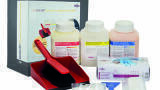
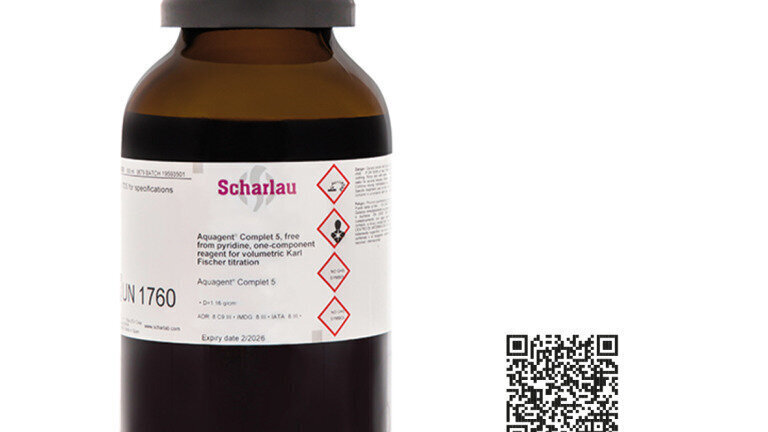
The first KF reagents developed contained pyridine in their formulation, supposedly essential for the reaction, but later experiments showed that pyridine only acts as a buffer substance and could be replaced by other basic compounds capable of carrying out the same function. For this reason, the new Karl Fischer Aquagent® reagents contain imidazoles instead of pyridine, alternative bases with good buffering capacity that allow stable titration end points to be quickly obtained.
The newly developed manufacturing and control method allows us to launch a new Aquagent® with multiple advantages for the user.
Scharlau’s new Aquagent® formulations achieve a more stable and robust Karl Fischer factor, faster stabilisation, a greater reaction speed and a more stable endpoint.
Leading manufacturers of Karl Fischer titration equipment, including Metrohm, Mettler-Toledo and Hanna, recommend Scharlau’s Aquagent® reagents.
More information online
Lab Asia 33.6 Dec


 Product directory