
Autoclaves
Confidence that your autoclave is sterilising effectively is essential, as there is no such thing as partial sterilisation. Ensuring your autoclave is performing correctly can be achieved in a variety of ways. One unsubtle method might be to crank it up to maximum settings and run it longer than the recommended cycle time — an approach more suited to waste loads than to anything sensitive to heat and pressure.
To optimise an autoclave’s processing time and temperature — and thereby improve energy efficiency — a combination of two different but compatible procedures can ensure both performance and reliability: calibration and validation.
Ever noticed how one oven burns food at 180°C, while another undercooks it? That comes down to calibration.
Calibration is the process of checking that an autoclave’s instruments — such as temperature sensors, pressure gauges, and timers — are reading accurately. This is done by comparing the autoclave’s measurements against a known standard, following internationally recognised protocols such as ISO/IEC 17025:2017.
Single-point calibration confirms that the machine is operating within accredited specifications, typically under UKAS standards. Each sterilisation temperature that the autoclave is required to operate at is calibrated individually, ensuring that when the autoclave indicates it is running at a given temperature, it truly is.
Autoclaves can be calibrated during manufacture, and are usually recalibrated several times throughout the year to ensure there is no drift in sensor accuracy.
However, while calibration confirms that the autoclave is measuring conditions correctly, it does not prove that the items being sterilised are actually reaching the required temperature throughout the load. This is where validation becomes essential.
To continue the oven analogy, you may have noticed that food placed in some parts of your oven cooks faster than in others, and that different combinations of items can change cooking performance. The same can be true in an autoclave, which is why load validation is so important.
Validation is a more detailed procedure that provides evidence that an autoclave can sterilise a specific load consistently and effectively. Multipoint validation involves placing temperature probes at a wide range of points within a dummy version of a standard load and recording the temperature distribution during a sterilisation cycle.
By measuring temperature changes across the load, the process evaluates critical factors such as steam penetration, air removal, and whether all parts of the load reach the required temperature for the necessary time.
Where the autoclave load is likely to remain consistent — for example, the same number of bottles containing the same volume of liquid — a dummy load is produced and documented to replicate this situation. This allows the validated load to be reproduced each time sterilisation occurs.
Where the load is less predictable — such as a bag of discarded material — validation testing is carried out under worst-case conditions, such as the largest or most difficult load the autoclave is likely to process.
The results from multipoint validation allow engineers to develop dedicated sterilisation programmes tailored to particular loads, which is especially beneficial for complex items. At the end of the process, a detailed validation report is issued, including cycle parameters, load descriptions, and often photographs to ensure operators load the chamber consistently in future cycles.
Calibration is a routine necessity to confirm that the autoclave’s instruments are accurate, while validation ensures that the sterilisation process works effectively for real-world loads.
In regulated industries, validation provides documented proof of compliance and reliability. Across all sectors, it provides assurance that a load is being sterilised in the most time- and energy-efficient manner possible for that machine.
Even if an autoclave is new and has been tested before dispatch, regular calibration and validation are recommended throughout its working life, particularly as equipment ages. Together, these processes help ensure sterility, safety, and confidence in critical operations.
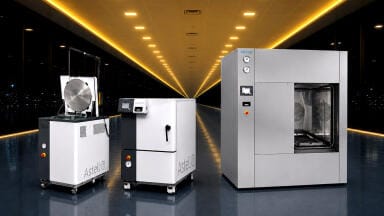
Astell Services can provide calibration and validation for all Astell autoclaves, ensuring your equipment is built to your laboratory’s needs and configured to meet your unique operational requirements.
ILM 51.6 Sept 2026


 Product directory





















.jpg)