Chromatography
Published over 5 years ago. See the latest and most current information on Chromatography.
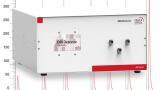
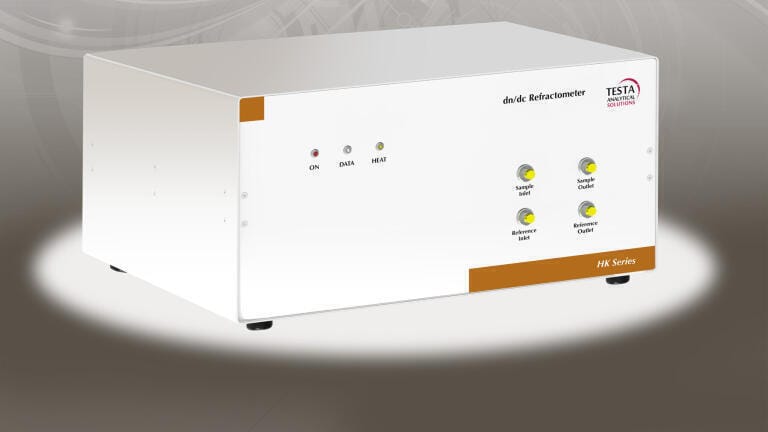
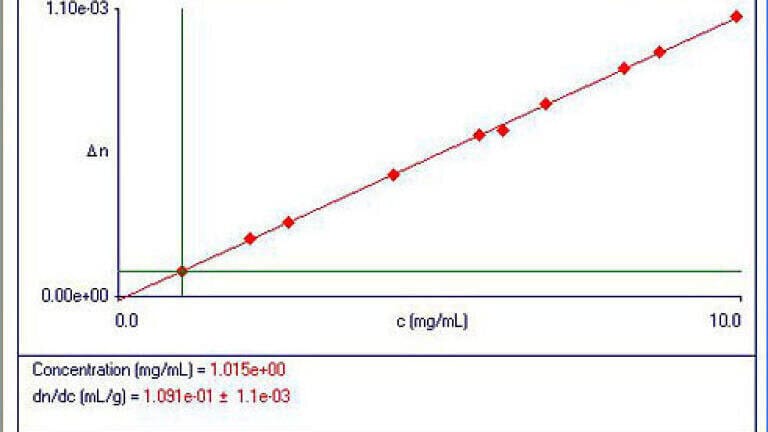
The new HK Series Differential Refractometer from Testa Analytical Solutions eK sets a benchmark for precise determination of specific refractive index increment (dn/dc) - an important parameter for polymer and protein molecular weight determination using light scattering techniques.
The specific refractive index increment (dn/dc) is one of the most underestimated parameters in material science. The assumption that using the approximate values for many polymers and proteins in published literature will not have a huge impact on molecular weight values determined by light scattering experiments, with or without GPC/SEC separation is incorrect. Because dn/dc is a squared term in the Debye Constant of the Zimm equation, any error in determining dn/dc will result in introducing considerable errors into molecular weight determination. In addition to this, precise determination of dn/dc within a GPC/SEC application, is extremely useful in order to calculate mass-balance of the separation, and therefore determine presence of absorption on the column which can again negatively influence any results calculated.
The HK Series dn/dc Differential Refractometer is a flexible device that may be used in either static or dynamic mode. In static mode, the specific refractive index (dn/dc) of dissolved samples can be easily and precisely determined in just a few minutes. Beneficially, the new system offers a large number of wavelength options enabling precise matching of your light scattering detector laser operating wavelength, thereby ensuring reliable and reproducible results every time.
Where the dn/dc value of the sample is already known, the HK Series dn/dc differential refractometer can be used for precise and sensitive concentration determination. The amount of sample used for this can also be easily recollected and therefore utilised for further investigations.
More information online
ILM 51.6 Sept 2026





 Product directory