Chromatography
Published over 17 years ago. See the latest and most current information on Chromatography.
Thermo Fisher Scientific Inc recently announced that a programme initiated by the Genome Consortium for Active Teaching (GCAT) would provide undergraduates with access to the Thermo Scientific NanoDrop™ 1000 spectrophotometer. The GCAT programme uses National Science Foundation (NSF) grants to purchase laboratory instrumentation, and encourages colleges and universities to adopt the use of DNA microarrays in their undergraduate curricula through student genomic research. With the help of GCAT resources, undergraduates design
and perform experiments, ship their microarrays to a GCAT site for scanning, and then download and analyse their data. GCAT assists higher education institutions by providing essential analytical tools, free access to information and results through its web site, and email distribution list of more than 300 subscribers worldwide
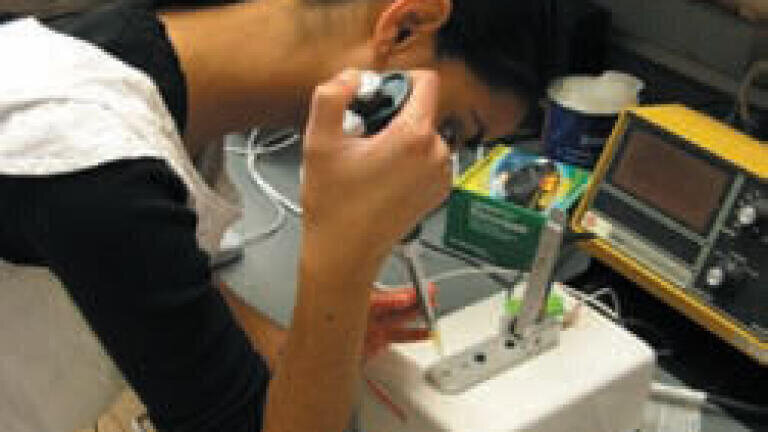
According to Dr A Malcolm Campbell, Founding Director of GCAT and Professor of Biology at Davidson College, the NanoDrop 1000 eliminates a number of common problems for undergraduates. Its unique sample retention technology allows students to conserve precious samples, which can be time-consuming and costly to prepare. Using conventional methods, students would use up to 40uL of a sample, which was not retrieved from the cuvette. As the NanoDrop 1000 does not require the use of cuvettes, wasted sample is reduced and the
associated costs are eliminated. By installing the NanoDrop 1000, students have been able to significantly reduce the time spent on analysis as well as eliminate the need for costly reagents.
The GCAT programme still has a number of challenges, including faculty training and providing undergraduates with access to microarrays and instrumentation. GCAT renewed four years of funding from the Howard Hughes Medical Institute (HHMI), enabling GCAT to buy and scan more chips for undergraduates. In addition, future NSF funding will enable GCAT to donate more laboratory instrumentation to eleven more schools where it is most required.
ILM 51.6 Sept 2026

 Product directory