Laboratory microscope
Published over 11 years ago. See the latest and most current information on Laboratory microscope.
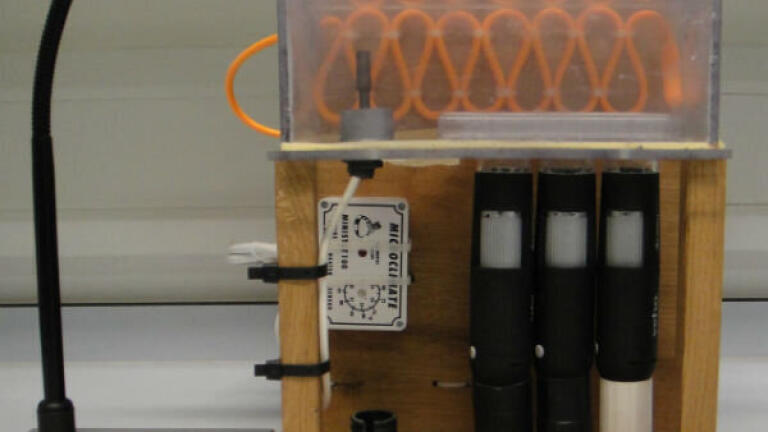
A PhD student from Brunel University London, who created his own microscope by adapting three cheap instruments he bought online is using his cut-price version for a study to understand if a snail’s immune system responds to chemical pollutants present in water, which might influence the levels of transmission of Schistosome parasites from snails to humans.
At an estimated cost of around £160 Adam Lynch thinks his microscope could be made cheaper still, said: “When you're looking at motility in cells you're only interested in the data – how fast the cell gets from A to B means more than a high-resolution image. Even with a high-cost microscope you will reduce the image down so that it's just a black dot on the screen moving against a white background so that it's easier for a computer to read.”
Adam clamped a USB microscope upside down on a table to produce the same images as the much more expensive inverted microscope.
“It worked ok as I could sort of see cells, which are about 50 micrometres long, but the images weren't fantastic,” he said. “But people don't realise that you can quite easily make a high-magnification microscope, it's just a matter of getting a lens and the right angle of lighting, so when I turned off the lighting that came with the instrument and used external lights I found I could see the cells quite clearly.”
Lynch AE, Triajianto J, Routledge E (2014) Low-Cost Motility Tracking System (LOCOMOTIS) for Time-Lapse Microscopy Applications and Cell Visualisation. PLoS ONE 9(8): e103547. doi:10.1371/journal.pone.0103547
ILM 51.6 Sept 2026



 Product directory