
Laboratory products
Published over 14 years ago. See the latest and most current information on Laboratory products.
Small-angle X-ray scattering is a well-established method for nanostructure analysis and contributes to a deeper understanding of the relationship between a material’s structure and its physical, chemical and biological properties. It is used to investigate structures from 1 nm to 200 nm present in many different kinds of liquid (e.g. colloids, proteins, surfactants) and solid (e.g. polymers, fibres, nanocomposites) samples.
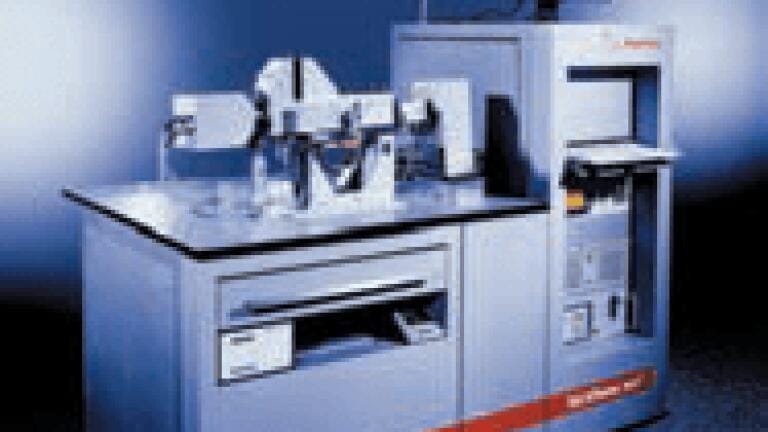
SAXSess mc² is the ideal tool for nanostructure analysis. It assures the highest data quality within short measurement times. Compact size, reliability and ease of operation are the attributes of this small genius. The SAXSess mc² system comprises different powerful X-ray sources, sample stages and advanced detection systems. All devices are integrated in a compact platform requiring a minimum
of lab space.
The heart of the system is the well-proven SAXSess instrument which has become a real asset to many renowned research labs worldwide over the last years.
The SAXSess mc² system allows time- and temperature-dependent experiments to be performed fully automatically. Clever sample handling stages make high-throughput screening of liquids and solids as well as grazing-incidence scattering (GI-SAXS) studies of nanostructured surfaces easily possible.
The powerful SAXSquant software controls all system devices and effortlessly processes large scattering data sets using customisable templates.
Applications
• Surfactants
• Biomaterials
• Microemulsions
• Polymers, nanocomposites and fibres
• Liquid crystals
• Particle dispersions
• Catalysts (zeolites)
• Nanostructured surfaces
Research Topics
• Nanostructure analysis (shape, size)
• Specific surface (porosity)
• Crystallinity and orientation effects
• Aggregation studies
• Dispersion stability testing
• Investigation of particle growth processes
• GI-SAXS studies of nanostructured surfaces
For more information: www.anton-paar.com
ILM 51.6 Sept 2026





 Product directory


















.jpg)
.jpg)
.jpg)