Laboratory products
Published over 5 years ago. See the latest and most current information on Laboratory products.
Asynt has published a case study describing how the FroSyn Cooling Station has enabled John Bower’s Group at the University of Liverpool to reproducibly conduct low temperature enantioselective catalytic reactions, over an extended period of time.
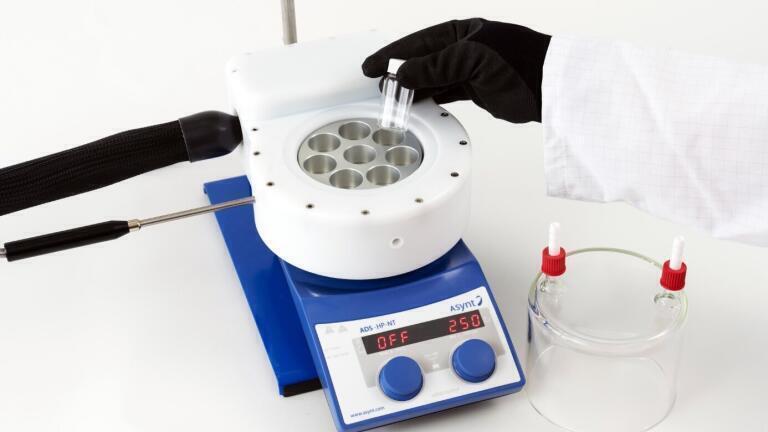
The FroSyn system, jointly developed by Asynt and temperature control specialists, Julabo UK, offers a versatile, stand-alone solution to low temperature synthetic chemistry without the drawbacks of traditional reaction cooling using dry ice/solvent baths.
Dr Karim Bahou of the John Bower Group commented in the case study: "We are very pleased to have purchased a FroSyn for our low temperature synthetic chemistry research. By using the vial insert supplied with the device, we can set-up several parallel reactions in order to test different reaction conditions at low temperature, at the same time. When we want to scale-up, we are able to do this simply by switching the insert to allow round bottom flasks up to 500 mL to be used. It is a neat and tidy solution that occupies only a small part of the fume hood, with the added benefit of no more cumbersome cooling baths."
Using a Pt100 sensor positioned in its insulated baseplate, the FroSyn provides precise, active temperature control down to -60°C, eliminating temperature fluctuations over time. This innovative approach to sample cooling results in excellent reproducibility and improved reaction control. Unlike dry ice cooling baths that require constant attention, the stable and controlled sub-ambient performance of the FroSyn means that unattended overnight reactions can be performed with complete confidence. Positioning of the FroSyn on top of a conventional magnetic stirrer enables efficient sample mixing during cooled experiments. Advanced thermal insulation, around the cooling probe and plate, not only improves performance, but keeps the apparatus ice-free and helps eliminate the possibility of operator cold burns during reactions.
To download a copy of the case study click here
More information online
ILM 51.6 Sept 2026



 Product directory


.jpg)











.jpg)
.jpg)