Laboratory products
Published over 13 years ago. See the latest and most current information on Laboratory products.
It is probably consensus among most chemists that thermometric endpoint titrimetry (TET) is a new technique. It isn't. In fact, it is 100 years old last month. Most texts on the subject credit the paper by James M. Bell and Charles F. Cowell published in the Journal of the American Chemical Society in January 1913 as being the first in the field. The reference to the original article (available from the American Chemical Society): DOI: 10.1021/ja02190a004 James M. Bell and Charles F. Cowell, Methods for the preparation of solutions of ammonium citrate. J. Am Chem. Soc. 35, 49-54 (1913)
Over the last century, TET was developed to solve practical problems in industrial chemisty that are not amenable to potentiometry (e.g., determination of sodium, aluminium, phosphate) It is exactly here, where it finds its best applications today. Moreover, TET is faster than potentiometry, requires no sensor maintenance, is insensitive to aggressive media, and is universal in that one sensor is suitable for all titration types: acid/base, redox, EDTA, precipitation, non-aqueous.
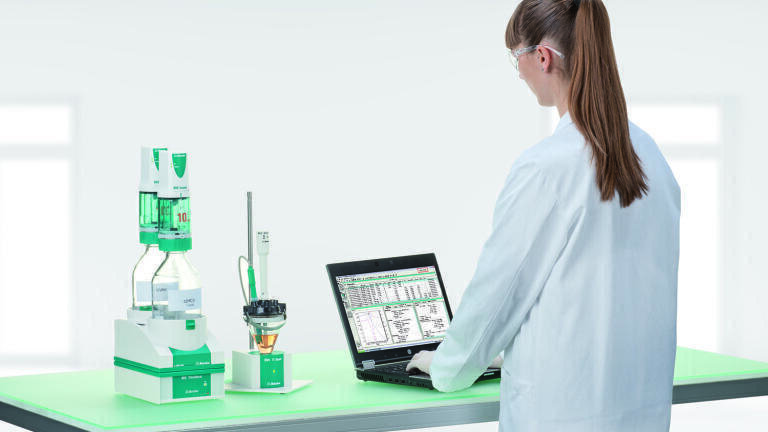
The most sophisticated titration system ever featuring the TET principle is the 859 Titrotherm. There have been many attempts over the years, but no company before Metrohm has succeeded in bringing such a practical thermometric titration system to the market which is so complete in every detail.
ILM 51.6 Sept 2026



 Product directory























.jpg)
