Research news
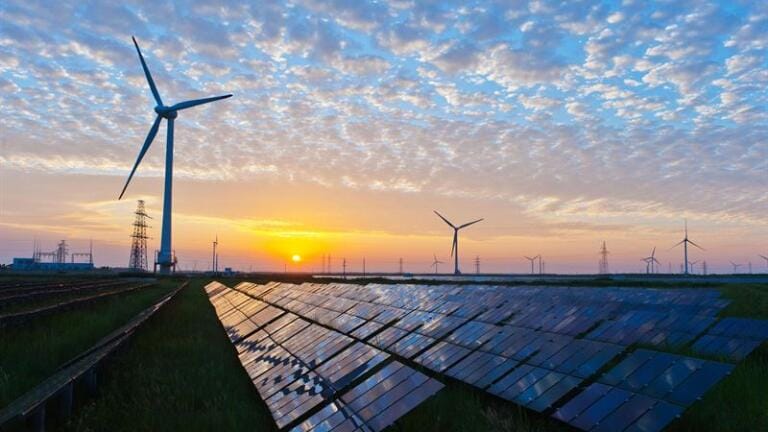
Researchers have developed a machine learning approach that predicts global growth pathways for wind and solar power using historical data from more than 200 countries.
Described as a computational ‘time machine’, the model simulates thousands of possible development scenarios to improve long-term forecasting of renewable energy expansion.
Developed at Chalmers University of Technology, the method suggests that by 2050 onshore wind could provide around 25% of global electricity, with solar contributing about 20%. This is broadly consistent with pathways aligned to a 2°C climate target, but below the trajectory needed for 1.5°C.
The researchers say the model captures real-world growth patterns more accurately than traditional approaches, which often assume smooth, continuous adoption. Instead, expansion tends to occur in bursts driven by policy and infrastructure changes.
“Most models assume smooth growth, but real-world adoption happens in bursts driven by policy and infrastructure changes,” said Avi Jakhmola, PhD Student at Chalmers University of Technology and first author of the paper.
They also validated the model by applying it to historical data, showing it can successfully reproduce observed developments over the past decade.
The study [1], published in Nature Energy, presents a new probabilistic, AI-driven method for forecasting low-carbon technology adoption.
More information online
ILM 51.6 Sept 2026



 Product directory




















,-photo-Karin-Allander.jpg)







.jpg)
