
Research news
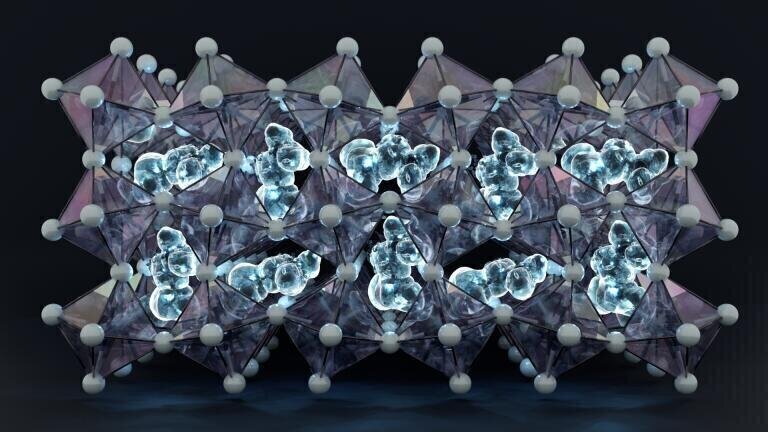
Researchers at Chalmers University of Technology, Sweden, have shed light on a long-standing mystery surrounding one of the most promising materials for future solar cells – formamidinium lead iodide, a member of the halide perovskite family.
Halide perovskites are considered strong candidates for next-generation solar cells and optoelectronics, thanks to their ability to absorb and emit light with high efficiency. However, their commercial use has been hampered by instability and a lack of detailed understanding of their atomic-scale structure and dynamics.
Using advanced computer simulations combined with machine learning, the Chalmers team has now identified the structure of formamidinium lead iodide at low temperatures. Their work resolves a ‘missing piece’ in the research puzzle by showing how formamidinium molecules settle into a semi-stable state during cooling.
The breakthrough, published in the Journal of the American Chemical Society [1], brings researchers closer to engineering perovskite materials that are both efficient and stable. To validate the simulations, the team collaborated with experimental researchers at the University of Birmingham, who confirmed the findings by cooling the material to –200°C.
“Our findings provide essential insights for engineering and controlling one of the most promising solar cell materials,” said Associate Professor Julia Wiktor. “The advanced simulation methods we now have can answer questions that were unresolved just a few years ago.”
As global electricity demand rises, more efficient solar technologies are urgently needed. Understanding and controlling perovskite structures could pave the way for lightweight, flexible solar cells capable of powering everything from mobile devices to buildings.
More information online
1. Revealing the Low-Temperature Phase of FAPbI3 Using a Machine-Learned Potential published in Journal of the American Chemical
ILM 51.6 Sept 2026



 Product directory


















,-photo-Karin-Allander.jpg)







.jpg)
