Research news
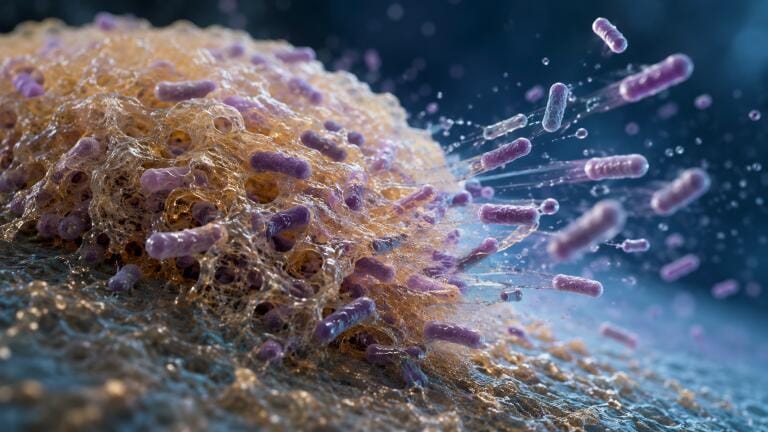
University of California San Diego scientists have discovered that ageing bacterial biofilms can force selected cells out of the community, a strategy that may point to novel ways to disrupt antibiotic-resistant bacterial colonies
Escape pod scenes have long been familiar fodder in science fiction, with characters ejecting out of doomed spacecraft in a bid to survive. Biologists at the University of California San Diego (UCSD) have now discovered that bacterial communities can use a remarkably similar strategy.
The researchers found that biofilms, dense bacterial communities that grow on surfaces, can force selected cells out of the colony when the wider community approaches the end of its life cycle. The finding challenges the previous view that biofilms simply dissolve when they face starvation or death.
Biofilms occur throughout the natural and built environment. They grow on submerged rocks, inside plumbing pipes and on the human body – including the skin and teeth, where they contribute to dental plaque.
Scientists from the laboratory of Professor Gürol Süel in the School of Biological Sciences at UCSD documented the ejection process for the first time in Bacillus subtilis.
“We found that at the end of their life cycles these bacterial biofilms forcefully ejected specific cells from the community,” said Professor Süel, a professor in the Department of Molecular Biology at UCSD.
“The biofilm senses that it is in trouble so it shoots cells out of the community like an escape pod,” he said.
The work was led by graduate students Todd Kwang-Tao Chou and Alejandra Dau-Martinez. Using high-resolution imaging, the researchers observed biofilms at single-cell resolution, which allowed them to study the extracellular matrix, the molecular scaffold that holds bacterial cells together and helps biofilms adhere to surfaces.
To investigate the mechanics of the process, the UCSD team collaborated with colleagues at Universitat Pompeu Fabra in Spain. Mathematical modelling revealed that the ejection force came from a self-generated hydrogel formed by the polymer gamma-polyglutamic acid (γ-PGA). This material can absorb more than 1,000 times its own weight in water. As it expanded, it generated enough force to propel cells through the surrounding biofilm and into the external environment.
The researchers said this mechanism could help stressed biofilms preserve part of the bacterial community. Rather than every cell dying in place, some escape, swim away with the potential to establish colonies elsewhere.
“The biofilm knows it is going to die, so it ejects some of its cells so they can survive and live to fight another day,” said Professor Süel.
The discovery surprised the team because comparable mechanisms appear to be rare. The researchers reported that jellyfish are the only animals known to use a similar form of forceful cell ejection.
The team then manipulated the process through genetic and chemical approaches. They showed that biofilms could be forced to rupture by increasing γ-PGA production.
The finding could have practical importance because biofilms are often highly resistant to antibiotics and contribute to chronic infections – as well as contamination of medical, industrial and domestic surfaces. By exploiting the biofilm's own physical machinery, researchers may eventually be able to disrupt harmful bacterial communities without relying on antibiotics or toxic chemicals.
“We show that biofilms can be forced to break apart without the need for antibiotics or toxic chemicals, by simply overproducing γ-PGA,” the researchers wrote in their study.
The authors also suggested that the work may provide broader biological insights. Tumours, like biofilms, can release cells that spread elsewhere, although the two systems differ fundamentally. The researchers proposed that understanding the physics of cell release could offer conceptual clues about how dense cellular communities disperse.
The findings add to growing evidence that bacterial biofilms behave in far more organised ways than once thought. Rather than form passive clusters of microbes, they can sense stress, alter their structure and deploy a last-resort escape mechanism that allows part of the community to survive.
For further reading please visit: 10.1038/s41564-026-02413-4
ILM 51.6 Sept 2026



 Product directory


















,-photo-Karin-Allander.jpg)




.jpg)
