Research news
A blueberry-sized capsule has been designed to transmit continuous temperature readings from the gastrointestinal tract, with potential use to detect infection, protect patients under anaesthesia and monitor fever at home
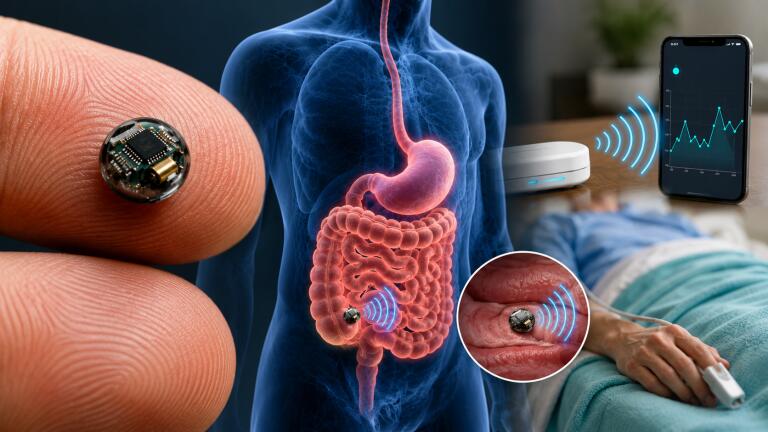
Massachusetts Institute of Technology (MIT) engineers have developed a tiny ingestible sensor that can transmit continuous core body temperature data from the gastrointestinal tract, a design that could help clinicians to detect infection earlier and monitor patients at higher risk from fever or temperature instability.
Body temperature is typically taken by a physician with an oral or often a tympanic infrared thermometer. These methods are convenient but do not always reflect core body temperature accurately because they measure temperature at or near the body surface. A device able to measure temperature from inside the body could offer a more direct way to assess whether fever has begun to develop and whether a vulnerable person needs closer observation.
The size of the MIT device is only six millimetres in diameter and four millimetres in height similar to a small blueberry. The team reported that the capsule was much smaller than existing ingestible temperature sensors, many of which are closer to the size of a larger multivitamin capsule and can be more difficult to swallow. Larger capsules can also carry a greater risk of causing an obstruction in the gastrointestinal tract.
“A sensor like this gives us the ability to monitor infections and identify them early,” said Dr. Giovanni Traverso, an associate professor of mechanical engineering at MIT, who is also a gastroenterologist at Brigham and Women’s Hospital and an associate member of the Broad Institute of MIT and Harvard.
“That’s very relevant, particularly for at-risk populations like people who are immunosuppressed from chemotherapy treatments or immunosuppressive drugs,” he said.
Traverso and Dr. Anantha Chandrakasan, MIT’s provost and the ‘Vannevar Bush’ Professor of Electrical Engineering and Computer Science, were senior authors of the study and Dr. Saransh Sharma, a postdoctoral researcher at MIT, was the lead author.
Most commercially available ingestible temperature sensors have remained relatively bulky because they contain electronic systems that require power from onboard batteries which can account for much of the capsule’s volume. However, the MIT team were able to reduce the size of its main components:
“The reason for them to be small is safety. We wanted something that is so small that the risk of any blockage or obstruction is highly mitigated and also so that it can be easily ingested,” said Traverso.
The researchers designed a customised circuit that fits on a one-square-millimetre silicon chip. They reduced power consumption by use of an oscillator based on leakage current, the small current that flows through a circuit even when it is switched off. Because the frequency of this current varies with the temperature around the chip, the device can infer local temperature.
The team reported that the circuit could detect temperature with an accuracy of 0.01 degrees Celsius while requiring only 10 nanowatts of power. This low energy demand means that the device can run on a 1.55-volt coin-cell battery measuring 4.8 millimetres in diameter and 1.6 millimetres thick.
The design has also reduced energy demand through backscatter communication. Most of the power demand is shifted to an external antenna outside the body, positioned 30 to 60 centimetres from the sensor. It emits an ultra-high-frequency radio wave which a miniature antenna inside the sensor modulates and sends back. By reading the change in the returned radio wave, the external antenna can calculate the temperature value.
The internal antenna sends a temperature reading once every second. Continuous core temperature data could help to detect infection earlier in immunosuppressed people and could help clinicians to observe patients during and after anaesthesia because anaesthetic drugs can disrupt normal temperature control and leave patients at risk of hypothermia.
The researchers also envisaged use beyond hospital care where the sensor could help parents to track fever in children at home, provide more precise core body temperature measurements as a marker of ovulation, or support temperature surveillance in athletes, military personnel and people exposed to extreme heat or cold.
To explore these uses, the team tested the sensors in animals under anaesthesia and found that the devices could detect and transmit temperature information accurately. They also obtained accurate readings from awake, actively mobile animals, which suggested that the system could function despite movement.
The group now aims to combine the temperature sensor with other sensors able to measure vital signs such as heart rate. The researchers said that they hoped to start clinical trials within the next few years.
For further reading please visit: 10.1038/s41928-026-01643-y
ILM 51.6 Sept 2026



 Product directory



















,-photo-Karin-Allander.jpg)







.jpg)
